Monday, March 13, 2006

okinawa (day 1)


3 days in Okinawa. The temperature was 24C (75F) during the daytime. We saw a lot of sights and ATE a LOT of food...

Our first day, started with spam musubi at the Naha airport. Our flight was during lunchtime so we didn't have much time for lunch. For most people in America, spam is looked down upon as "poor people" food. In Hawaii and in Okinawa, spam can definitely be found in most family's pantries. In Hawaii, you can get spam with eggs and rice for breakfast and can find spam musubi in the convenience stores. It is a good finger food especially when travelling. In Okinawa, they call spam musubi, pork tamago nigiri (spam, egg rice ball). These musubi are huge and had tsukudani (sweetly seasoned seaweed) inside. Each family whether in Okinawa or Hawaii has their own original way to make this musubi.

Our first sight seeing stop was Shuri-jo (Shuri Castle). This castle is modeled after a castle in China. One thing you will notice is that there are a LOT of Chinese influences in Okinawa. In the Shuri-jo bathroom, there were shisa faucets. The shisa is a lion-like figure that is usually found at the entrances of Okinawan homes. The shisa on the right will usually have its mouth open. This symbolizes the male who is protecting the home. The shisa on the left will usually have its mouth closed. This symbolizes the female who "grabs" onto happiness and doesn't let it go. Since it is spring in Okinawa, there were lots of flowers, this was an area with a lot of impatiens.

Our next stop was Okashigoten, a large factory which makes a lot of Okinawan cookies and sweets. One item that they sold were andagi. Andagi is the Okinawan donut. These donuts are fried but no sugar is put on the outside. We tried 3 different kinds (From left clockwise: kokuto (black sugar), goma (sesame) and plain). Many Okinawan families have their own original recipes.

We then went to check-in at our hotel, Mahaina Wellness Resort. The word mahaina is a cut and paste of different chinese character meanings: ma (the best state of something), hai (south), na (wave). It was thought that most explorers came to find their new lands on the "best south waves". Dinner was a buffet. Warning: if you go to most buffets in Japan, be prepared to be pushed around by other customers and have them cut in line to take their food...
Here's my first round: pink container (nigana tofu, bean curd with bitter leaves) rice with radish soaked in ukon (tumeric) and radish soaked in acerola (not pictured), on plate: from left clockwise, goya champuru (bittermelon with egg and tofu stir-fry), ku-buirichi (konbu (seaweed) stir fried with carrots and pork, vegetable salad with okinawan carrots, radish and umi-budo (which are these little salty roe-like seaweed that resembles tiny grapes), papaya-irichi (green papaya stirfried with pork, carrots and chives), naberanbushi (hechima (loofah gourd) stewed with chicken and miso (soy bean paste)), so-ki (pork ribs stewed in seasonings until the meat falls off the bone).
My second round from top clockwise: beni-jagaimo (red potato), somin champuru (stir-fry with somen (like cappelini) and goya (bittermelon), coconut cookie, coconut tart, goya champuru and so-ki.

Mahaina Wellness Resort
1456 Yamakawa
Motobu-cho, Kunigami-gun, Okinawa
Phone: 0980-51-7700

Thursday, March 09, 2006

crochet

Today was my bead crochet class. We made a 3-layer dome ring. It took the whole 2 hours! I'm pretty pleased with how it came out. (Sorry the photo is a bit dark and green...)

This weekend we're off to Okinawa. It is my mother-in-law's 77th birthday. She's wanted to go to Okinawa not only to see the sights, but also to take a photo in the traditional costume.

In Japan, the 77th birthday is called kiju. The chinese characters for kiju means "joyous year", in the early days for someone to live to the age of 77 was definitely fortunate. There are other interesting meanings for different years.

One is at 60 years, it is called kanreki. It is thought to be the second birth of the person. The calendar was based on the chinese characters and the lunar system and was organized on a 60-year cycle, so it is thought that life returns to its starting point at the 60th year. At the 60th celebration, the guest of honor wears a red vest and red cap. These symbolize the clothes worn by babies and the return to his/her birth.

80 years is called sanju, 88 is called beiju, 90 is called sotsuju and 99 is called hakuju.

Beiju is written with the character for rice. Rice was respected by everyone not only as a staple but also a symbol of their livelihood and happiness. A fundamental part of Japanese society, rice also symbolizes purity and goodness. The 88th birthday is celebrated as a very happy and joyous occasion.

Have a nice weekend!!

Wednesday, March 08, 2006

registered alien

Today I had to go to pick up my gaikokujintoroku (foreigner's card) or as they have it on the top of the card, "certificate of alien registration" (do we call foreigners in America, aliens too?). I was kind of excited to get a new card, because it meant a new photo. The first time I applied for this card was 5 years ago. I took the photo on my own, by going into a box which takes photos for various applications (passports, college applications, resumes. Can you believe you have to put your picture on your resume?). This time, I went to a photo shop in the shotengai (shopping arcade) where we live, the thing is you aren't allowed to smile. I don't know why...so, now I'm stuck with a mad looking photo for the next 5 years...oh, well, at least I have the card, right?

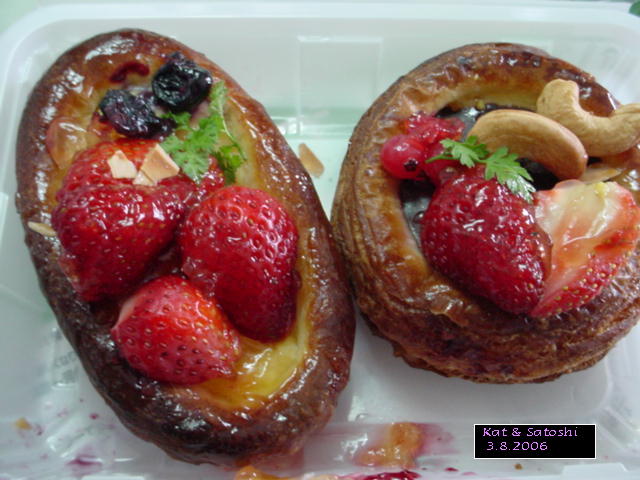
On my way to the city office, I looked forward to going to my favorite bake shop, Abientot. They had all kinds of breads. I bought a croque-monsieur. It is a ham sandwich which is grilled, it had a bechamel sauce, ham and broccoli on top. Also, an eggplant, bacon pizza. And strawberry brioche & strawberry ganache. The brioche and ganache had custard cream inside and strawberries and fruits on top. Everything was very good!

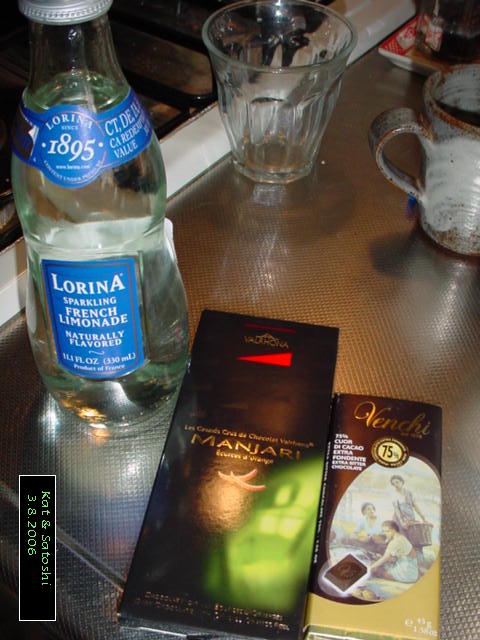
Another thing I looked forward to was roaming the aisles of the gourmet supermarket. It is on the way from the city office to the train station. I found some interesting food things. I remembered on Bea's blog that she talked about Lorina drinks. This sparkling drink is from France. I bought the Sparkling Natural Limonade. Valrhona's Manjari, also from France. A dark chocolate with orange peel. And Venchi, an Italian Dark Chocolate.

So now I'm a registered alien with lots of good food.

sunny day = laundry

It's funny, now that I am a housewife (sengyo-shufu = full-time housewife...does this mean I qualify for retirement someday?), a sunny day during the week isn't means for outings. Oh, sure, I do go for longer walks on my way to the grocers. But in essence, a sunny day during the week means laundry day. I love to hang our clothes/towels outside (especially when the other neighbors on the other floors aren't smoking on their lanais(we call them lanais in hawaii, in Japan these are called verandas, in other countries they are probably called balconies...) And feel a bit confined when I have to hang them inside because of rain, cloudy weather or the smokers.

I'm not too sure if I told you or not, but the washing machines here in Japan only have cold water washing. This means during the winter you are basically swishing your clothes around in ice water and hoping they come clean...there is also a hose that connects from the washing machine to the furo (bathtub). This is so that you can re-cycle the bath water and use it to wash your clothes. What it does is suck up the bath water, and filter the water as it transfers it to the washing machine. Still, I usually try to wash our towels or sheets with this water. The washing machine also doesn't have the agitator in the middle or the holes in the basket to drain (this is to prevent mold from forming on the outside of the basket (the areas you can't see), as mold is thought to be one of the causes of atopic dermatitis (atopi) here). The load takes about an hour (if you are adding softeners...so be prepared to spend some time doing a load or two...)

Another thing you'll see is that there are a LOT of detergents, softeners and stain remover products on the market. There is even a product that boasts not having to iron if you add it to your wash. I think I tried most of them. Although, I know our clothes aren't as clean as they could be if we used American detergents, the water is hard here and the detergents are made to "protect" the environment, and with all the mixtures of chemicals, I'm sure they aren't doing much for our skin.

Oh, and when hanging your clothes outside, don't drop them, the lanais are so dirty with this greyish dust probably from pollution, that you have to re-rinse or re-wash whatever you drop! (trust me, I've done this several times...)We don't have a clothes line instead we have these l-o-n-g metal poles called monohoshizao (poles to dry things on), so I usually put the clothes onto hangers and then use these big clips to keep them from flying off the poles (the crows also like to steal hangers so that's another reason for the clips). If I'm hanging towels, I usually have to wipe down the poles before doing so because of the dust. And I'm sure we must be breathing in that dust too (probably a reason why some people have asthma (zensoku) here too). Still with all these cons on washing clothes, I still enjoy a sunny day to do laundry, and if our washer should ever "die" (knock on wood) I have my eyes on a washer that has a dryer built in...

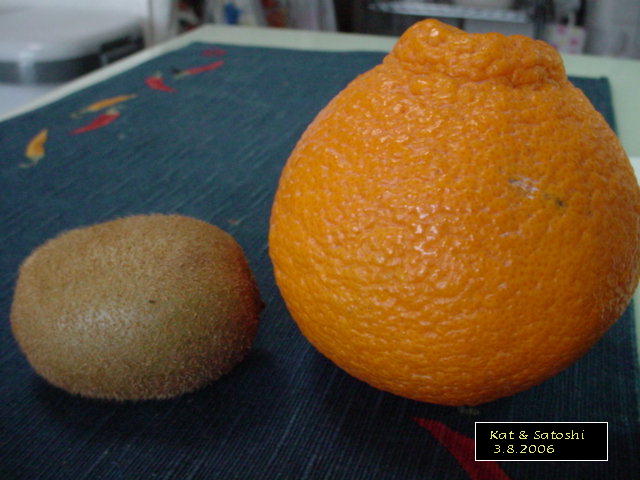
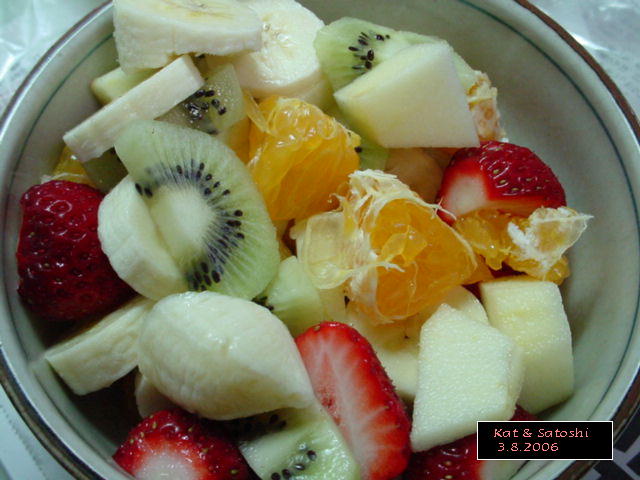
Changing the subject, we got this dekopon from a member of Satoshi's staff. (I decided to take a photo of it next to a kiwi so you could see how big these dekopon are.) Dekopon is a cross between a kiyomi orange and a ponkan. Ponkan is a citrus fruit originally from an area called Poona in India. The Japanese took the Pon from Poona and kan from the Japanese word for citrus, kankitsu and made up their own word for this citrus fruit, which is similar to an orange, and called it ponkan. So, why is it called dekopon? Deko means bump. I think when they crossbred it the new fruit had a little bump at the top, so they named it dekopon. I combined it with some other fruits for a fruit salad.

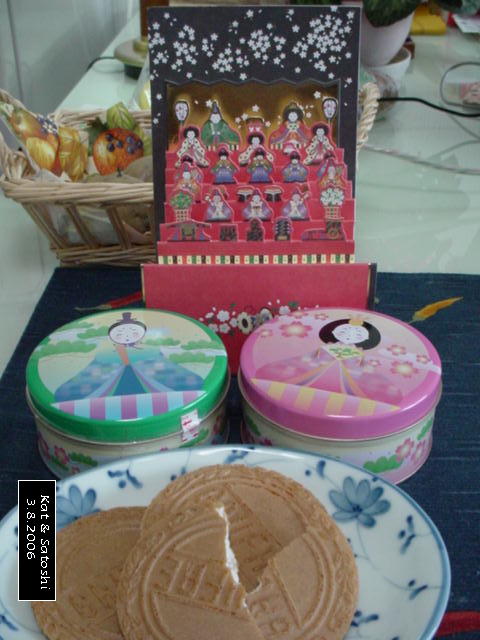
I also wanted to share with you what Satoshi gave to me for Girl's Day. A hinamatsuri card and also these sweet treats called "Gaufre" (I think it is short for Gaufrettes) These thin wafer-like cookies have flavored cream in the middle. In a package, there is strawberry, vanilla and chocolate. Made by Kobe Fugetsudo , they are sold in these colorful tins(so the cookies don't break). They often have different themes decorating their tins.

Monday, March 06, 2006

relaxing = tea & incense time

What do you do to relax? I usually turn off the TV, put in a CD and listen to something like "Josh Groban" or "Jake Shimabukuro", read a book/magazine or look through a glossy cookbook. Since coming to Japan though, I've added a few new things to do. Burn incense, have tea.

Living in Hawaii, I rarely had tea and rarely drank anything hot for that matter. Everything was iced this or that or just water. But one thing that I noticed in Japan is that a lot of women drink tea. All kinds of tea. I guess this is why my addiction to buying cookbooks is accompanied by buying all kinds of tea (among other addictions...). I had previously written about BOH tea here.

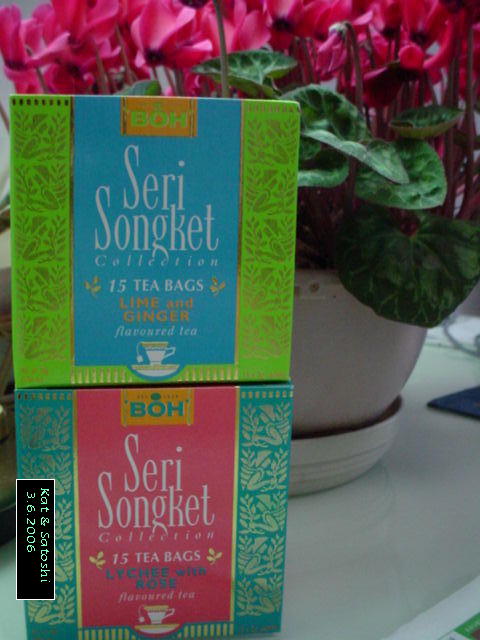
Well, while roaming an import grocery store this past weekend, I found 2 more flavored teas by BOH. Lime with Ginger & Lychee with Rose. Lime with Ginger has a very light lime-citrus taste, the spice of ginger comes to "zap" you awake towards the end of your cup. Lychee with Rose was also nice. The lychee fragrance is very delicate and doesn't overpower the rose flavor of the tea. They were both really nice cups of tea.

A little off this subject, my parents (who live on Oahu) are now travelling with a group in Okinawa, they landed in Osaka and left for Okinawa over the weekend. Although we didn't get to visit with them (you should see their itinerary!), my mom sent some cookies and coffee for my in-laws, my host-family & of course, some for us!
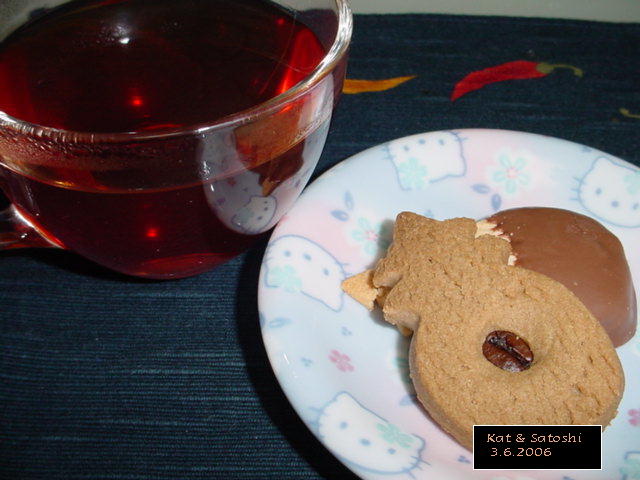
The cookies she sent to us were from the Honolulu Cookie Company. These shortbread cookies have pieces of dried fruit, or a coffee bean, some are dipped in milk or white chocolate. I like these cookies, but my favorite is the "king" of the dipped cookies, Big Island Candies. Big Island candies was the first in the Hawaiian Islands to come up with the idea to dip shortbread cookies in different chocolates (they have a dark chocolate dipped cookie!) When my grandmother lived on the Big Island (the island of Hawaii), we used to religiously stop at Big Island Candies to "stock up". Now that she lives on the island of Oahu (the island with Waikiki), we don't get to the Big Island as often. If only Big Island Candies would lower their shipping rates. (hint, hint!!) Anyway, having tea with a little sweet treat is definitely a way to relax and just "veg".

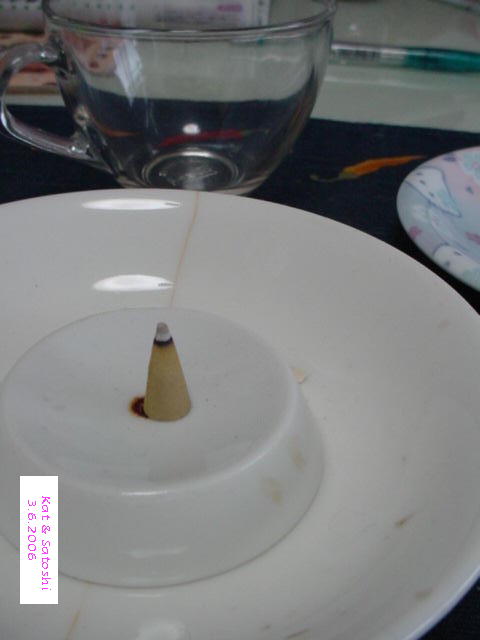
Another way I like to relax is to burn a little incense. Incense is called O-ko or senko here. Senko is usually what you see at Buddhist temples and is burned to "take your prayers up" through the smoke from the incense. O-ko is burned more for relaxation and fragrance (or that's how I understand the two). I looked on the internet to see how incense was made: they are often made with essential oils, plant matter and intended to release a fragrance for religion, therapy or aesthetics. There are different forms and uses for incense, coil shaped-the mosquito repellants, cone shaped, cored sticks-these have a piece of bamboo or sandalwood in the center and solid-sticks-these have no wood in the center but are made entirely of the incense materials. If you do try burning incense as a way to relax, please remember to watch where you burn it so that you won't have a fire on your hands. Also, try to have a window open, so that you won't breathe in the smoke from the incense. Still, it is a way to relax and clear your mind of things. I really enjoy the citrus-y and flowery fragrances such as freesia, lavender, rose and orange.

If you'd like, it would be nice to hear about how you like to relax.

Have a nice week.

sharing

After a great sunny weekend, the rain is back...

I just got through reading the summer edition of Crema Magazine. It is a magazine for "Australia's pre-eminent coffee lifestyle". It was filled with all kinds of articles about...coffee, travel & wine (my favorites!) I particularly enjoyed reading a little about the history of the espresso machine, Berlin's cafes & cakes (kaffee & kuchen) and of course, Australia's cafe scene.

I'm always taking down cafe, restaurant & dessert/food info of places around Osaka, Kyoto, Kobe & Tokyo from magazines, television and the internet and am slowly making my way around to try them. The Japanese call getting information this way, kuchikomi (by word of mouth or through the grapevine). Also before travelling, I tend to surf the net for info on places to eat, what to eat and foodie things to buy.

While reading this magazine, I also took down the cafe info from this magazine (just in case I go to Australia...) I wanted to share the cafe info (for those of you living in Australia):
KAFA
224 Commonwealth St, Surry Hills, NSW 2010
Phone: (02)9280-2624
Coffee by: Boutique Sydney roaster-Campos

Butterfly
25 Cookson St, Camberwell, VIC 3124
Phone: (03)9882-1649
Coffee by: Gravity
Breakfast served all day.
Pides and baguettes are popular at lunchtime. (By the way, what are pides?)


Bite
24A Ralph St, Alexandria, NSW 2015
Phone: (02) 9669-2412
Coffee by: Allpress Espresso
"Breakfast promises to become an institution-come by early for fresh fruit salad with coconut sorbet or toasted brioche with goa's cure, poached pears and rocket!"

lb2
Shop2, 1-3 Carre St, Elsternwick, VIC 3185
Phone: (03) 9528-6440
Coffee by: Gravity
Black Sesame Tuna Salad is most popular item at lunchtime.

Pulse
Shop2, 332 Kent St, Sydney
Phone: (02)9290-2137
Coffee by: Sydney's Voodoo Coffee-the organic blend, Sacred Grounds
Specialty: organic burgers

Also, if you are in search of a job at an Aussie cafe, here's a website that gives job info:
www.cafescene.com.au

It is intriguing to read an Australian English magazine. Although it is in English, I realized that American English and Australian English are very different. There are so many terms I don't know, like the pides which I mentioned previously. Also, I came across rashers and lovage. I went to the dictionary to see if I could find a meaning and only came across meanings for the latter two. I'm hoping my Australian friends will let me know what pides are!

Enjoy!

Sunday, March 05, 2006

foodie saturday

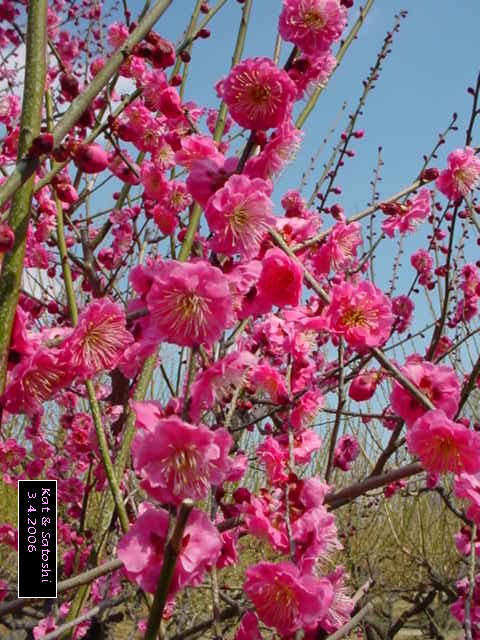
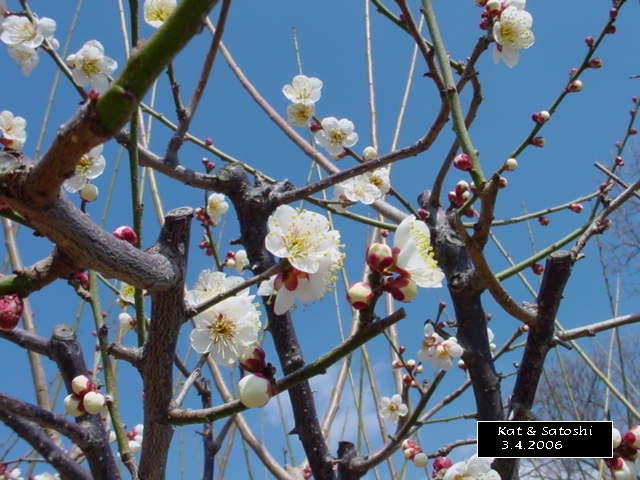
Today was a beautiful sunny day. After my lesson, I met Satoshi and we walked to a nearby park, Suigetsu park. I had only known about the hanashobu (irises) that are beautifully grown and displayed in June. And only had learned about the ume (plum)grove, recently through a local newsletter. I had walked through the park a week earlier and the buds of the plum trees were just beginning to form. This weekend, there were a few trees that had bloomed. Here they are.

After walking through Suigetsu park, we stopped into MOS burger for a snack. (MOS stands for mountain, ocean and sun. I really like this fast food restaurant because they use vegetables grown in Japan (they have a chalkboard which they list the farms and areas that they got their veggies from). Plus, they make your burger or food item only after they recieve your order. This means it is always fresh and HOT!) They have a new item called, katsu-curry rice burger. Katsu (fried pork) with a curry sauce, shredded cabbage, and a little pasta salad all between two "patties" of rice (sorry no photo). We shared this and it was really good and really hit the spot.

After our little snack, we walked to the Hankyu Ikeda station. It is about 1 km from our station, Hankyu Ishibashi. From Ikeda, we caught the train to a station called Nakayama. At Nakayama, they have a community of temples for different praying purposes, but they also have an ume grove. During our first winter in Japan, we had a picnic breakfast at this grove amongst the ume blossoms. The weather was still very cold, but to be amongst the blooms was still very nice. Unfortunately, they weren't in bloom yet.

We decided to stop in for tea at Factory Nakata. The Aramaki shop is about half-way between the Hankyu Yamamoto station and the Nakayama station. They only have about 10 seats, so if you want to eat your cake there, be prepared to wait.

When you walk in, you see a huge showcase filled with assorted cakes. And as you walk further into the store there are many displays of the awards that the pastry chef/owner, Hiroshi Nakata, has recieved over the years, as well as different boxed gifts for purchase.

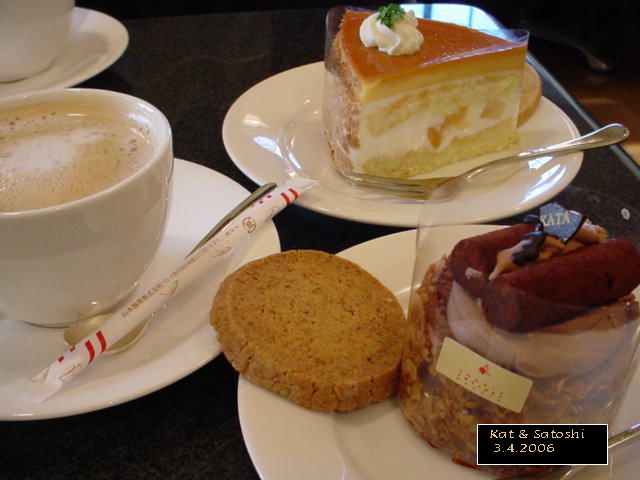
I had the Charlotte Chocolat which was a chocolate sponge cake filled with chocolate whipped cream and chopped almonds then covered with sliced almonds and topped with namachoco (chocolate truffle sticks) and an oatmeal cookie (this came free). Satoshi had the Pudding tart which was a yellow sponge cake filled with whipped cream and fruits and topped with a layer of custard flan and a shortbread cookie. The only gripe I have about this cafe is that they allow smoking. I understand that smokers have to have a smoke after eating, but I would like to enjoy my cake and coffee too!! I think the next time we enjoy these sweets would be to take out. (UPDATE: all Nakata shops are out of business)

Suigetsu Park
3-6-1 Hachizuka
Ikeda city, Osaka Prefecture

Factory Nakata-Main shop (UPDATE: no longer in business)
2-10-8 Hiuchi
Kawanishi city, Hyogo Prefecture
Phone: 072-740-3336

Aramaki shop
4-2-10 Aramaki
Itami city, Hyogo Prefecture
Phone: 072-778-0501

Kawanishi Hankyu counter
Aste Kawanishi Hankyu Department store B1 dessert area

Satoshi is working today, hope you are enjoying your weekend!