Showing posts with label laundry. Show all posts

Thursday, November 01, 2018

"real" dryer

Nearby we have several coin laundries and they have "real" dryers.

Not like the one we have attached built-into our washer.

Since the temps seem like it will finally start to drop, we went to "fluff" up our futon and other thicker blankets.

For 100 yen, you can use the dryer for 12 minutes.

If you want to use it for longer, you need to add more money, 100 yen per 12 minute intervals.

12 minutes was perfect for our blankets, though we had to make two trips (once for the futon and one more for the thicker blankets), but, at least the coin laundry we went to was close by.

I am pretty sure I will be using these dryers during the winter.

Tuesday, May 22, 2018

dryer

Wondering why the built-in dryer of our washer is so "weak"...look how teeny the filter is.

There are 3 filters...but still.

No wonder it takes forever for things to get completely dry.

My peeve with this built-in dryer (besides the fact that the clothes do not get completely dry) is that the clothes do not "relax" in the dryer, they dry as a scrunched up ball...which increases my ironing work load...oh well, we'll see what happens when rainy season starts...

Thursday, November 02, 2017

lifehack

I've been using this lifehack for some time now, and recently told a friend about this.

Most washers in Japan do not have the thingy in the middle to wash the clothes.

Because of this, the clothes end up all tangled in a big ball.

But, if you put two empty 500 milliliter plastic bottles with the caps on into a net, and wash your clothes...

The middle of the washer ends up being cleared and most times the clothes do not tangle.

If you have the same type of washer, and do try this, I hope it works for you too.

p.s. thanks Rowena for reminding me to post about this :)

Saturday, July 12, 2008

laundry

Recently Rowena posted about hanging laundry in Italy. I commented and she wrote back saying she wanted to see how we hang laundry here.

So, with the help of the big condo across the street, I'll show you a glimpse at how most of us are hanging out our laundry. I usually don't hang our laundry outside because someone in our building likes to smoke out on their lanai, so my nicely washed clothing/towels always smell like someone has been smoking next to them (insert pouty face).

First off, our lanai have these attachments in which you slide your metal poles into. (Not all apartments have these) These attachments are adjustable, they can be put at 90-degrees, or 45-degrees. Then all the way down when you aren't using them.

If you hang something directly onto the poles (like towels), I would recommend wiping down the poles. You wouldn't believe how much black "stuff" is actually in the air.

The poles can be bought from hardware stores or even large supermarkets. These guys are about 3 meters when not expanded but can go to about 5 or 6 meters long.

Imagine Satoshi and I with these poles in a teeny crowded bus lugging them back to our place so that I can hang laundry. Yup, we didn't have a car when we first came to Japan (and still don't because public transportation is that good), so everything we bought was either brought back by ourselves or delivered by the store we bought it from.

The pink gadget at the end of the pole was bought from the 100 yen store. This is to insure that the poles do not free themselves from the attachment with the wind. Especially during typhoon season, you wouldn't want these "pole vaulting poles" to be hurling themselves through the air.

Unlike a clothesline, you need to put your clothes onto a hanger then hang them onto the pole.

Most people have a clip that secures the hanger to the pole. This is to prevent crows from taking the empty hangers to make their nests and to keep the clothes from flying away.

Also, on sunny days many people air out their futon (Japanese comforters). You can hear them beating them with sticks (bam bam bam). This lady was out on her balcony, you may be able to see the stick in her hands. Actually, I don't like the idea of beating them, because you are releasing "stuff" into the air as well as letting your "stuff" go onto the futon/laundry that is airing one floor down...eew.

For me, I don't mind the laundry hanging out, but I do feel that hanging the futons over the side are a bit of an eye sore.

Hope you are enjoying the weekend.

Wednesday, March 08, 2006

sunny day = laundry

It's funny, now that I am a housewife (sengyo-shufu = full-time housewife...does this mean I qualify for retirement someday?), a sunny day during the week isn't means for outings. Oh, sure, I do go for longer walks on my way to the grocers. But in essence, a sunny day during the week means laundry day. I love to hang our clothes/towels outside (especially when the other neighbors on the other floors aren't smoking on their lanais(we call them lanais in hawaii, in Japan these are called verandas, in other countries they are probably called balconies...) And feel a bit confined when I have to hang them inside because of rain, cloudy weather or the smokers.

I'm not too sure if I told you or not, but the washing machines here in Japan only have cold water washing. This means during the winter you are basically swishing your clothes around in ice water and hoping they come clean...there is also a hose that connects from the washing machine to the furo (bathtub). This is so that you can re-cycle the bath water and use it to wash your clothes. What it does is suck up the bath water, and filter the water as it transfers it to the washing machine. Still, I usually try to wash our towels or sheets with this water. The washing machine also doesn't have the agitator in the middle or the holes in the basket to drain (this is to prevent mold from forming on the outside of the basket (the areas you can't see), as mold is thought to be one of the causes of atopic dermatitis (atopi) here). The load takes about an hour (if you are adding softeners...so be prepared to spend some time doing a load or two...)

Another thing you'll see is that there are a LOT of detergents, softeners and stain remover products on the market. There is even a product that boasts not having to iron if you add it to your wash. I think I tried most of them. Although, I know our clothes aren't as clean as they could be if we used American detergents, the water is hard here and the detergents are made to "protect" the environment, and with all the mixtures of chemicals, I'm sure they aren't doing much for our skin.

Oh, and when hanging your clothes outside, don't drop them, the lanais are so dirty with this greyish dust probably from pollution, that you have to re-rinse or re-wash whatever you drop! (trust me, I've done this several times...)We don't have a clothes line instead we have these l-o-n-g metal poles called monohoshizao (poles to dry things on), so I usually put the clothes onto hangers and then use these big clips to keep them from flying off the poles (the crows also like to steal hangers so that's another reason for the clips). If I'm hanging towels, I usually have to wipe down the poles before doing so because of the dust. And I'm sure we must be breathing in that dust too (probably a reason why some people have asthma (zensoku) here too). Still with all these cons on washing clothes, I still enjoy a sunny day to do laundry, and if our washer should ever "die" (knock on wood) I have my eyes on a washer that has a dryer built in...

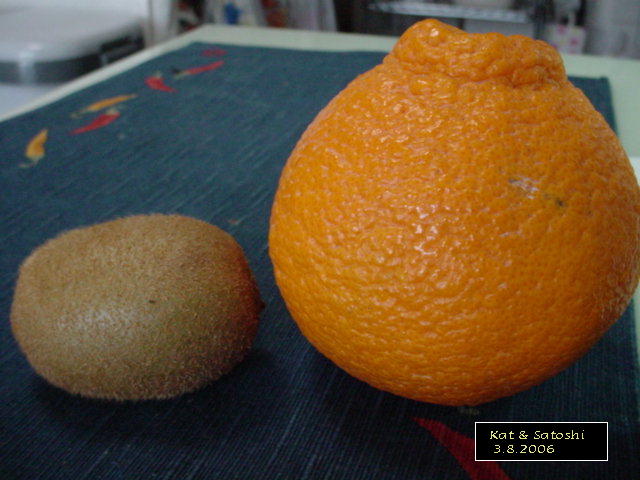
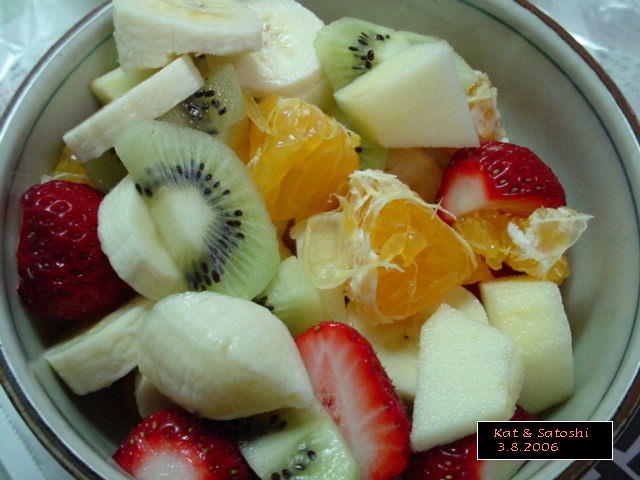
Changing the subject, we got this dekopon from a member of Satoshi's staff. (I decided to take a photo of it next to a kiwi so you could see how big these dekopon are.) Dekopon is a cross between a kiyomi orange and a ponkan. Ponkan is a citrus fruit originally from an area called Poona in India. The Japanese took the Pon from Poona and kan from the Japanese word for citrus, kankitsu and made up their own word for this citrus fruit, which is similar to an orange, and called it ponkan. So, why is it called dekopon? Deko means bump. I think when they crossbred it the new fruit had a little bump at the top, so they named it dekopon. I combined it with some other fruits for a fruit salad.

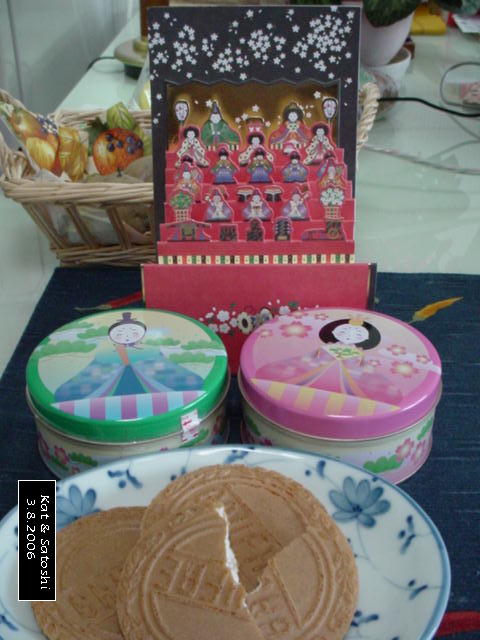
I also wanted to share with you what Satoshi gave to me for Girl's Day. A hinamatsuri card and also these sweet treats called "Gaufre" (I think it is short for Gaufrettes) These thin wafer-like cookies have flavored cream in the middle. In a package, there is strawberry, vanilla and chocolate. Made by Kobe Fugetsudo , they are sold in these colorful tins(so the cookies don't break). They often have different themes decorating their tins.