Showing posts with label history. Show all posts

Monday, December 13, 2010

historical walk

Recently on my walk, I ran into some historical spots...

Like this enclosed area which houses the remains of a large sugi (cedar tree), which I think is that thing that looks like a wet spot in the next photo.

(In older photos that I've seen online, there was actually a stump.)

It is said that when the sun rose in the mornings, the cedar would cast a shadow all the way to Ikeda (nearly 2 kilometers away) and was the pride of the city.

The oblong stone monument in the photo dates back to 1677.

Unfortunately, in 1991 a strong wind toppled the tree down.

On the right side of the stone monument is another large cedar and a kuroganemochi (round leaf holly) tree, which made me think that the one that fell must have been really tall!

Down a bit from this stone monument is an atagosha, a place that houses a charm to protect against fires.

In the olden days, a very tall tower with a bell would sit next to a barber shop and the barber and volunteer firefighters would take turns to watch for fires.

When a fire arose, someone would scurry up the ladder and ring the bell with a hammer/mallet to warn everyone.

After reading about this, I remembered that near our house is a volunteer firehouse and that nearby is also a barber with a tower in front.

(I had always wondered why there was a tower next to the barber shop and now I know why.)

So, I went to check it out and it looks exactly like the tower I saw on my walk.

Only thing is that the tower I saw the other day didn't have a barber shop nearby, I guess times change.

Getting back to the atagosha, the charm that it houses was brought from Kyoto's Mount Atago, which I've read that if you visit the shrine there, you can pick up an amulet. The atagosha in Minoo has been there since 1691.

(This tower is probably not used these days, this one had lots of television antennae attached)

(A close-up of the hut that houses the fire protector charm.)

Down the hill from the charm and tree remains is an inari-jinja.

The Inari god is the god of harvest.

This particular shrine is actually part of the Sakuragaoka kofun (Sakuragaoka tomb).

The tomb dates back to the 6th century.

The Seimaru-inarisha (shrine) was created for the people in the area to pray for good crops.

The "backside" which still houses the tomb, has city protected trees such as kuroganemochi (round leaf holly) and mukunoki (apahnanthe) planted around it.

There are still many places to discover, and it has been interesting and fun to find out more about our city. I'm glad our city has more "natural" areas than "concrete" ones.

Wednesday, September 22, 2010

foodie monday in minoo

Satoshi had Monday off, which was a holiday, so we went to see a movie. The Japanese movie "Umizaru, the last message" was in 3D, think BP oil rig meets Japanese Coast Guard.

The ticket price was 200 yen (about US$2) more than what we would have normally paid, which is normally 1800 yen (about US$18) by the way, so it was 2000 yen (about US$20) per person. If you wanted to bring home your 3D glasses, you could, I figure we paid for them, so why not??

Anyway, I was amazed at how technology has changed, the glasses are not with one lens red and the other blue, they are grey. The movie on the other hand has a red and blue tinge to it.

I've seen 3D televisions on the market here and can't imagine what type of vision people who have bought them must have.

After the movie, we went to check out Hakodate Ichiba, which is a conveyor belt type sushi place.

Most of their selections weren't too impressive, though two stood out for us.

A seared maguro (which could've been more seared) topped with ra-yu (chili oil).

The other was grilled eringi (mushroom) topped with some yuzushio (citron flavored salt).

After lunch we walked to check out a historical site, Kayano Sanpei's house.

This house belonged to a young samurai who also wrote haiku under the pen name Kensen.

This young samurai was apparently torn between filial piety and loyalty to his lord and in the process committed suicide on the anniversary of his lord's death...kinda dramatic, yeah??

In 1973 this house was considered a historical site by Osaka and in 1992 the house was donated to the city of Minoo.

In 1993, an addition was built called "Kensen-tei" which is continually used for haiku gatherings and tea ceremonies.

Satoshi went to check out this guy's grave which is located in a different area away from the house, so while I waited for him, I admired all the rice fields.

Satoshi was amazed at how much "country" there was where we live.

To get home, we tried out our city's community bus, which I touched upon the other day here.

I found out that this is actually a new system in our city.

Before, there was a bus only for senior citizens, but they have changed it and now anyone can ride the bus.

There are 5 lines (red, green, yellow, pink, blue). Depending on the route, for 200 yen, you can ride almost anywhere in Minoo.

To pay your 200 yen fare (as you get off the bus), you can use bus coupons, pre-paid/post-paid train debit cards or pay cash.

And if you want to transfer to another line, then you need to ask the driver for a transfer, and the transfer ride will cost you 100 yen (about US$1) cash only.

Not the most convenient transportation system for us because they run about once every hour (some lines are more infrequent), but it was a good experience and we hope to use it whenever we have extra time to get from one place to another.

Overall, it was an overcast day, kind of humid but not as bad as the week before.

We have another holiday coming up in a couple of days. Hope you have a great week.

Friday, March 26, 2010

happyaku-bikuni

There is a story of Happyaku-bikuni (800 year old nun), which tells of the longevity of the people of Obama.

In Obama, there once was a rich man named Takahashi Gondaiyu. One day, he was invited by a fisherman for dinner.

He went over to the fisherman's house and happened to see the kitchen area. The food that they were preparing was something he had never seen before.

One of the dishes that they brought out was a platter of sliced ningyo (mermaid). Skeptical of eating the ningyo, Gondaiyu ate the other foods and didn't touch it.

The fisherman insisting that this ningyo was gochisoo (special foods for a special occasion) wrapped up the ningyo and sent it home with Gondaiyu.

Gondaiyu reluctantly brought it home and tucked it away in the kitchen where no one would see it.

That night, his 16 year old daughter found the wrapped ningyo and tried a piece. It was so delicious that before she knew it, she had eaten all of the sliced ningyo.

The next day, her father looked around for the ningyo but couldn't find it. His daughter confessed to eating it. Her father worried that something bad would happen to her because she ate it.

As the years passed, everyone but his daughter aged. More years passed and everyone in her family passed away leaving her still looking young but very alone and sad.

Everyone in the village gossiped that her youth was due to eating the ningyo.

Since she was alone, she decided to become a nun and travel around Japan to bring happiness to others. Everywhere she went, she planted a tsubaki (camellia) tree.

Finally when she was 800 years old, she returned to Obama and entered a cave. Near the cave she planted a single tsubaki (camellia) tree and told the people of the village, "when this tree dies, you will know that I too have died".

The tree still stands today next to the cave near an area next to the Yahata shrine.

Thursday, November 20, 2008

historical tour

One thing we did, was go on a historical tour. This tour takes you to various spots on the island. Many of these spots were involved in WWII.

Banzai cliff was where 10,000 Japanese jumped to their deaths in fear of being captured by the U.S. According to the guide, they shouted their mother's name, threw their children into the ocean then jumped.

Right above this spot is the last outpost of the Japanese army.

They let you crawl inside to see the post then walk down to view the many graves of those who jumped to their deaths from 248 meters above. Many jumping backward so as not to see the rocks below.

From the north end of the Island, we headed back to Garapan where there is the American Memorial Park. This national park shows the battles in Saipan and gives tribute to the people of Saipan, showing their recovery after the war.

We also went to Sugar Cane King Park. Haruji Matsue was responsible for starting the sugar industry and building a railroad in Saipan. Though the sugar industry and rail in Saipan are no longer existent, the idle engine for the sugar cane train still is.

There are many reminders around the Island that wars are evil and everyone hopes for peace, hopefully that will come true for the whole world one day.

Thursday, December 08, 2005

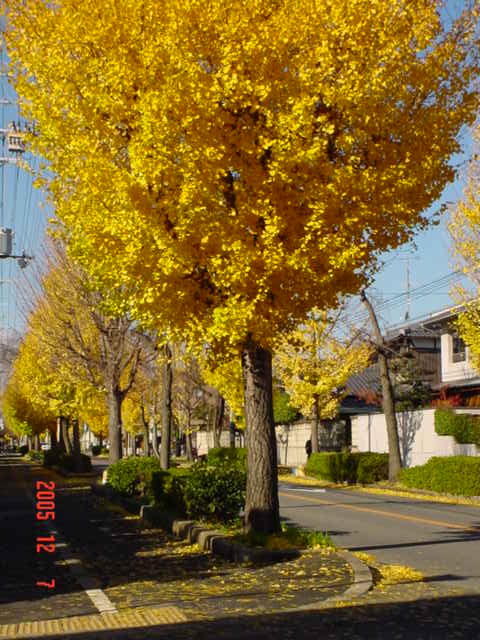
some history, gingko trees

Yesterday Satoshi had the day off, so we went to our favorite cafe, Hiro, for breakfast. The weather is FREEZING!! You could actually see snow on the Minoo mountain tops. The weatherman says we can expect the mid-winter conditions to continue (didn't winter just start??)

Anyway, after breakfast, I wanted to show Satoshi the gingko trees. They were a very bright yellow and it looked like a truck that had yellow paint in it, exploded. (I think I may have used that description a while back...) Anyway, in the sun, they looked a lot brighter.

We have some interesting history in Minoo, for one thing, in an area called Sakuragaoka, the Japan Architect Association sponsored a house remodeling exhibition in Taisho 11 (1922) which featured Western style houses. A total of 25 houses were built. After the exhibition, all of the homes were sold. Today, 8 homes have kept its shape and 4 of them have been registered as a National Treasure of Japan. This one was unique for its time because the contrast of the red roof tile and white walls. I was surprised because most of these houses are HUGE!!

When we go check out the other historical spots, I'll post my findings.

Keep warm if you're in areas like ours, and for those in warm areas, try to keep cool!!

Sunday, November 27, 2005

korakubiori

"Korakubiori" means nice weather to take a trip or go on an outing. Today, the weather was perfect for going out and about.

We started out early and walked to our favorite cafe, Hiro.

We usually go to the one in Minoo, but this time we went to the one in Kitaitami (it was our 2nd time here). It is actually the same distance from our place--about 2.5 km.

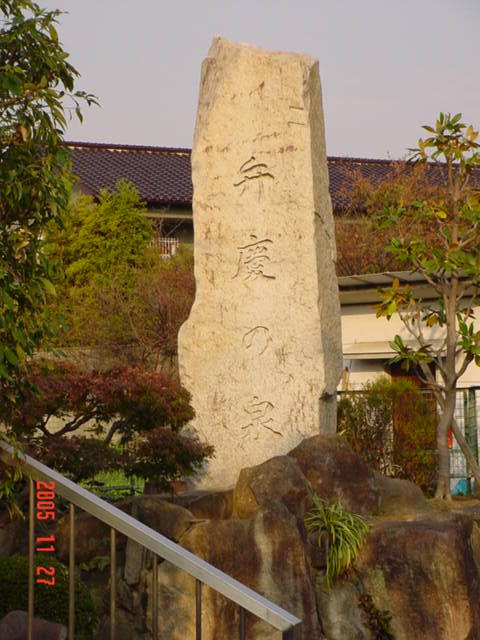
On the way to Kitaitami, we came across an "izumi" or spring.

Apparently, there are different stories, but the famous warrior Benkei stopped here for a drink on his way to Kyoto--so it is named "Benkei no Izumi".

The spring was and still is used by farmers to water their fields. To preserve the memory of Benkei there is a festival held every May 3rd.

After breakfast, I wanted to show Satoshi this field of nanten (nandina) plants that had changed colors.

Nanten is a member of the Barberry family and the leaves look like bamboo. It is sometimes called "Heavenly Bamboo".

On Tuesday, when I went to Nakayama, I came across this field of nanten. I took a picture with my cell phone and sent it to Satoshi. He was amazed to see the fields up close.

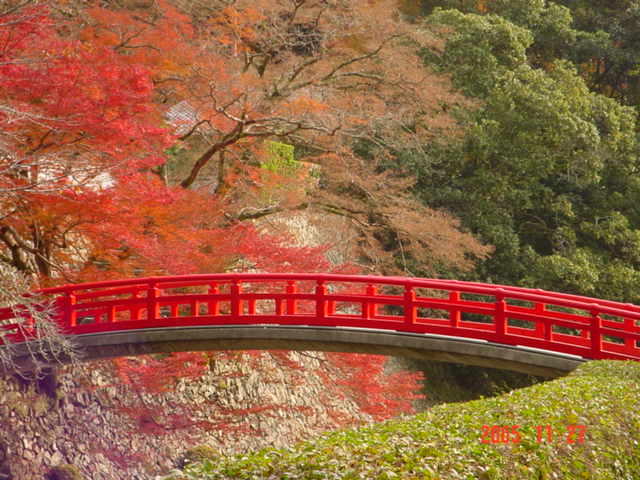
From Nakayama, we took the train to Minoo and walked all the way in until the Minoo Falls.

Along the way, we stopped at Ryuanji, a temple inside Minoo Park.

After going to the falls, we had lunch at an Italian restaurant called Vlla San Michele (I think they forgot the "i" in Villa). The food was very good, but unfortunately my camera's memory was full, so I have no photos to show. :(

Vlla San Michele (UPDATE: as of 4/08/2009 this restaurant is no longer in business)
5-12-16 Minoo
Phone: 072-725-0766
Closed:Mondays

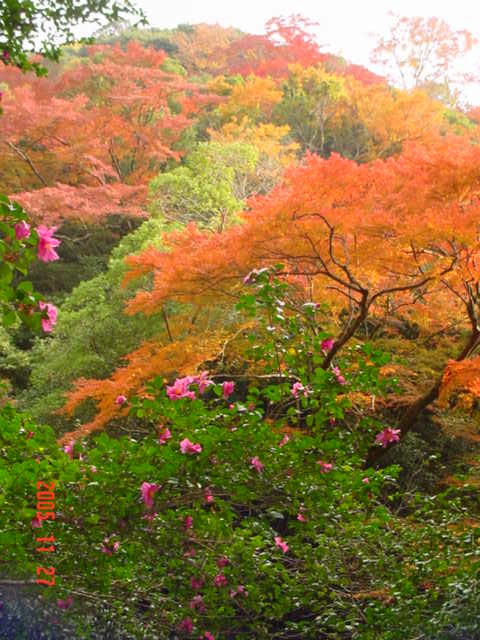
We sure did a lot of walking today (I think about 10km in all), but we got to see a lot of fall colored leaves. Hope you had a nice weekend and have a great week.