Thursday night's dinner...started off with making "furikake", a topping for rice.
This was daikon greens and jakko (dried small anchovy).
In a frying pan, heat about 1/2 tablespoon of sesame oil.
Add a handful of jakko and toss, then add chopped daikon greens and toss.
At the end I added a little dash of shoyu (soy sauce).
NOTES: I only had about 2 handful of chopped daikon greens and a handful of jakko, if you use more of either, I would suggest adjusting the shoyu and sesame oil.
For our main dish, daikon wrapped with pork.
This recipe was in Orange Page's "Fuyu ni Oishii kondate", which I adapted.
Serves: 2
200 grams of pork belly, thinly sliced
1 inch thick piece of daikon, cut into thin sticks
Sauce:
nub of ginger, grated
1/2 tablespoon roasted sesame seeds
1/2 tablespoon sake (rice wine)
1/2 tablespoon shoyu (soy sauce)
2 teaspoons mirin (sweet rice wine)
1 teaspoon sesame oil
green onion, chopped
some canola oil to cook in
Put sauce together and set aside.
Wrap daikon pieces with pork.
Heat canola oil and cook pork pieces well.
Add sauce and let liquid evaporate a little.
Before serving top with green onions.
Top your rice with the daikon furikake, about 1 tablespoon.
Serve with some miso soup.
Dinner is served, a lot of green and a good way to use all of the daikon.
NOTES: the recipe for the main dish actually called for pork loin, but of course I didn't read the recipe well and when I went to the market I just got something that was thin.
I think if I had actually bought pork loin, the wrapping of the daikon wouldn't have been so thick. I should have also cut the daikon more thin and matchstick-like, so that it could cook faster.
I think this would be nice with other veggies inside also like carrot and/or green beans.
This was rather quick and easy. Would definitely make this again.
p.s. another adaptation can be found here.
Kat & Satoshi's eating and traveling adventures around Japan (and sometimes Hawaii)
Showing posts with label jakko. Show all posts
Saturday, February 05, 2011
Tuesday, November 16, 2010
on the lanai
So I did, they were about 4 or 5 inches long.
The bigger of the 3 surprised us because we had been keeping our eye on the two smaller ones and hadn't noticed the bigger one until it was really huge.
So, thinking this would be a new way to prepare goya I asked her for her recipe.
This was our dinner on Sunday: goya tsukudani, miso soup with daikon, carrot and sweet potato, genmai (brown rice), egg & lettuce, and yuzu pickles.
The most simple way we eat them is to mix some with grated daikon and top with some shoyu or ponzu (citrus soy sauce).
I also place the mixture on tamagoyaki (rolled omlette).
Chirimen jakko was also part of the recipe that Kazumi gave to me for the goya tsukudani.
Here is the recipe if you'd like to try this.
Goya Tsukudani adapted from Kazumi : yields about 1/4 cup
150 grams goya, cleaned and sliced into half cm slices.
37.5 mililiters shoyu (2.5 tablespoons)
25 mililiters vinegar (1.6 tablespoons)
50 grams sugar
1.5 teaspoons roasted sesame seeds
1 gram hana-katsuo (bonito shavings)
5 grams chirimen jakko (dried small anchovies)
After cleaning the "cotton" and slicing the bittermelon, put into boiling water to blanch.
Put liquid condiments into a pot and heat on medium.
Add goya, stirring once in awhile.
Just before all the liquid evaporates, add the sesame seeds, katsuo & jakko.
NOTES: She didn't have measurements for the sesame seeds, katsuo or jakko, so the measurements are what I used.
I weighed the goya after I cleaned it.
Since the jakko is dried, I added it while I still had quite a bit of liquid.
All in all, it took about 30 minutes for all the liquid to evaporate.
The bittermelon still keeps its bitter bite but is made a little softer with the addition of sugar.
I think this would be nice in musubi.
Whew, this post was long, but I wanted to wrap everything into one post so that I could share with you the happenings from our lanai.
Adventure tags:
bell pepper,
bittermelon,
goya,
jakko,
lanai,
plants,
recipes,
vegetable
Monday, November 08, 2010
le weekend (the weekend)
Every year it is quite a large event and is usually held at a hotel banquet room.
After the party, his teammate from Gifu, stayed over at our place and brought us this nice box of Morozoff chocolates...thank you!
100 yen shopping arcade.
This event has been happening here and there in Osaka and around Japan to generate business.
Over the past couple of years, with big shopping malls popping up here and there, business for the neighborhood shopping arcades have somewhat staled and most times these shopping arcades end up closing for good.
It is a good way to get people to visit and see what they have been missing by shopping at the big malls.
It is also a nice way to buy things for just 100 yen or a dollar (higher if you calculate it to the actual dollar-yen rate).
I also bought two pieces of fruit cake from Bonnard, a little cake shop near the Sakurai station. I have always wondered what sorts of things they sold and this was a nice chance to try them. We enjoyed it, very moist with lots of dried citrus peel.
Total spent on this day 400 yen (about US$4).
This event was bigger than the Sakurai one.
The yuzu drinks and pickles were 150 yen each (about US$1.50) a little higher than 100 yen but still really reasonable.
In Minoo, there is an area called Todoromi, where there are lots of yuzu trees. I have heard of the Todoromi Yuzu Marmalade and have been wanting to try it. But I've never seen it in stores, I think I may have to order online.
Most of the weekend weather was nice, Sunday unfortunately was overcast. The upcoming week looks to be nice weather also.
Since Satoshi has a day off during the week, we'll probably go to visit MIL.
Hope you have a nice week.
Thursday, June 10, 2010
utsuwa chazuke
Utsuwa means bowl/dish and chazuke is cooked rice with green tea poured over it.
After removing the "dish" from the package, break it in half and put on top of your hot rice.
We bought 2 types katsuo (bonito)/konbu (seaweed) and jakko (whitebait)/shiitake (a type of mushroom)...210 yen (about US$2.10) each. One "dish" is actually one serving.
We shared both over two breakfasts and loved the flavors. (This would definitely be nice during winter.)
Tsukuda no Tsukudani
JR Kanazawa Omiyage Annex
Wednesday, May 27, 2009
nose
Last Thursday, I met up with my friend Kazumi and she took me up to Nose (pronounced no-say). This area has a lot of farms, I think there is even a dairy.We stopped at a roadside market and picked up some veggies. Everything was so cheap! I picked up some daikon, 2 for 60 yen (about US$.60) with the tops. Whenever you buy daikon in the supermarkets they cut off the tops! so you almost never get to cook with them, which is sad because the tops have lots of nutrients in them.
I also bought a package of spinach. There were about 8 small bunches in this package and only 105 yen (about US$1.05), a container of rakkyo (pickled scallions) for 600 yen (about US$6), this was the most expensive thing I bought but how can you go wrong with homemade?
We heard that if we had come earlier there would have been a better selection, still, we were happy with our purchases.
After buying our produce, we stopped into their restaurant for lunch. Their food is all homemade. We had their tofu hamburger set 840 yen (about US$8.40), this came with lots of different veggie dishes and the hamburger which had tofu mixed in. It also came with kodaimai (purple/reddish rice) which was also delicious.
After our filling lunch, we went to check out a little cafe nearby called Yamaboshi. This cafe just opened in April and Kazumi knew the architect who built it.
They have a light lunch menu and a dessert menu. We tried their dessert plate and we were so stuffed afterwards! The plate comes with a slice of chiffon cake, your choice of the dessert of the day and your choice of the gelatin dessert. All that with drink only 800 yen (about US$8), definitely worth the price (sorry no photo!).
The coasters were cute too, made to look like those origami aloha shirts.
On the top floor of the cafe is a little quilting school.
It was a great little cafe.
With the veggies I bought from the roadside market, I made takuan with the daikon. The recipe I used needed to be doctored, so I won't share it with you. Let's just say until I doctored it, it was super sour!With the tops of the daikon, I blanched them and chopped them up. With half of the tops, I added 1 can tuna (drained), 1 tablespoon yogurt (placed on cloth for 20 minutes to get out water), 1 teaspoon mayo. Mix well and top with sesame seeds.
The spinach, I wilted and served with ponzu (citrus soy sauce).
These are the times I wish we had a car, so I can go veggie shopping here. Thanks for a great day Kazumi!
Cafe Yamaboshi
45-86 Morigami
Nosecho, Toyono-gun
Osaka
Phone: 072.734.2227
Open 11:00-17:00
Closed Mondays & Tuesdays
Sunday, December 03, 2006
dashimaki tamago
Well, the weather has turned wintry overnight. I think the temperature dropped 5 degrees yesterday. The blustery winds didn't help either...Brr.
I had some dashi (stock) left over from my okara (soy bean curd lees) "creations", which I posted about here and here, so to use up some of it, I made dashimaki tamago (a type of rolled omlette).
Here's my recipe:
1 ladleful of dashi (stock)-can be either katsuo (bonito) or kombu (kelp) or combination of both
1 teaspoon of shoyu (soy sauce)
1 teaspoon of mirin (sweet rice wine)
1 teaspoon sugar (optional)
2 eggs
1. Put all ingredients into a bowl and beat with fork or chopsticks
2. Heat special egg pan, when ready, add 1/3 of egg to the pan
3. Rolling the egg from the rounded end of the pan (pink arrow on photo), in the direction of the other end of the pan (green arrow)
4. Move completed roll back to the rounded end of the pan and pour a little more of the egg mixture into the pan.
5. Re-roll the omlette.
6. Repeat steps 4 and 5 until all of egg mixture is gone.
NOTE: If you add sugar to the mixture, the egg mixture will brown quickly, so you'll have to keep an eye on it.
I didn't add sugar to the omlette today, instead I added chopped green onions. You can also add iwanori (a soft type of seaweed) or shirasuboshi(Kanto name)/chirimenjakko(Kansai name) (dried young anchovies (Eastern Japan)/(Western Japan)).
Also, I grated daikon (long white radish) and put it on top of the omlette.
Before eating, I poured a little shoyu (soy sauce on top). It went well with rakkyo (pickled shallots), ume (pickled plum), iwanori (soft seaweed) and rice.
A note about the rolling technique: I think you are actually supposed to be able to roll the omlette along with just a pair of chopsticks, but since my chopstick skills are a bit lacking, I usually use a spatula in one hand and a pair of cooking chopsticks in the other to guide it along.
Hope you have a great week!
I had some dashi (stock) left over from my okara (soy bean curd lees) "creations", which I posted about here and here, so to use up some of it, I made dashimaki tamago (a type of rolled omlette).
Here's my recipe:
1 ladleful of dashi (stock)-can be either katsuo (bonito) or kombu (kelp) or combination of both
1 teaspoon of shoyu (soy sauce)
1 teaspoon of mirin (sweet rice wine)
1 teaspoon sugar (optional)
2 eggs
1. Put all ingredients into a bowl and beat with fork or chopsticks
2. Heat special egg pan, when ready, add 1/3 of egg to the pan
3. Rolling the egg from the rounded end of the pan (pink arrow on photo), in the direction of the other end of the pan (green arrow)4. Move completed roll back to the rounded end of the pan and pour a little more of the egg mixture into the pan.
5. Re-roll the omlette.
6. Repeat steps 4 and 5 until all of egg mixture is gone.
NOTE: If you add sugar to the mixture, the egg mixture will brown quickly, so you'll have to keep an eye on it.I didn't add sugar to the omlette today, instead I added chopped green onions. You can also add iwanori (a soft type of seaweed) or shirasuboshi(Kanto name)/chirimenjakko(Kansai name) (dried young anchovies (Eastern Japan)/(Western Japan)).
Also, I grated daikon (long white radish) and put it on top of the omlette.
Before eating, I poured a little shoyu (soy sauce on top). It went well with rakkyo (pickled shallots), ume (pickled plum), iwanori (soft seaweed) and rice.
A note about the rolling technique: I think you are actually supposed to be able to roll the omlette along with just a pair of chopsticks, but since my chopstick skills are a bit lacking, I usually use a spatula in one hand and a pair of cooking chopsticks in the other to guide it along.
Hope you have a great week!
Monday, July 17, 2006
umi no hi
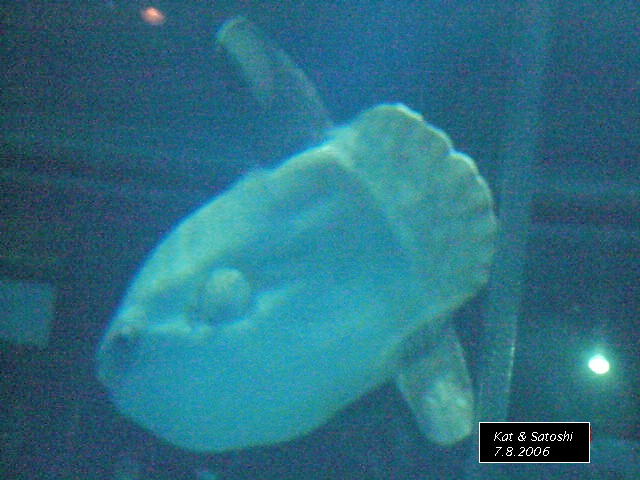
Today is Umi no hi (Ocean Day). It is a national holiday and Satoshi has the day off. It has been raining with lightning and VERY LOUD thunder--off and on for the past couple of days.Since we didn't have a chance to get to the ocean today, I thought I'd share with you a photo of a mambow (sunfish), on a recent trip with my family to the Osaka Aquarium.
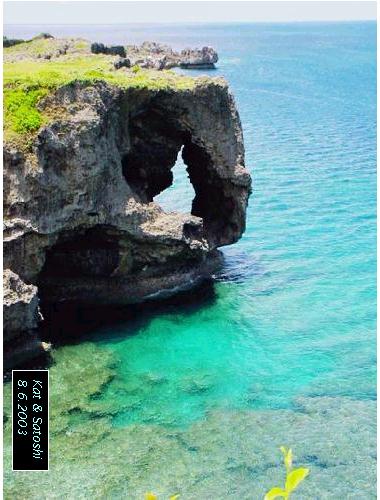
And a photo of Manzamo in Okinawa, which was taken a couple of years ago. It is a beautiful area but, this cliff was actually a site where many Okinawans plunged to their deaths for fear of being captured by America during the War.
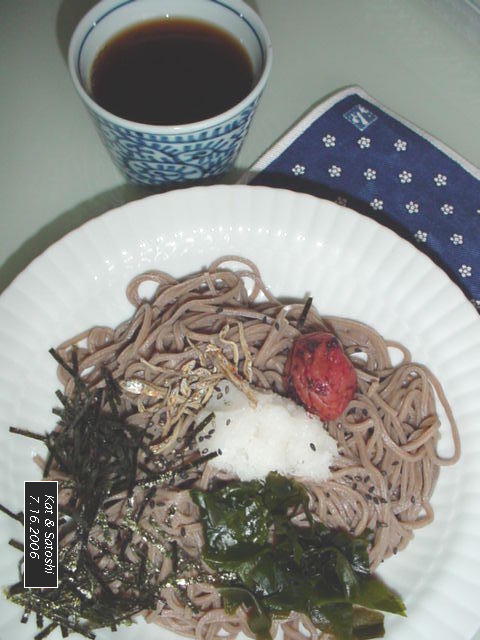
Lastly, I wanted to share a way to keep cool. Have a bowl of cold soba (buckwheat noodles). This version is called oroshisoba. Oroshi is the term for grated. You can put whatever toppings you wish--I served our soba with wakame (kelp), chirimen jakko also called shirasuboshi (dried young anchovy), thinly sliced nori (dried seaweed), oroshi daikon (grated turnip) and an umeboshi (pickled plum). The sauce called tsuyu--in the cup, is diluted a bit with water for dipping.Have a good week!
Subscribe to:
Posts (Atom)