Showing posts with label tokushima. Show all posts

Wednesday, February 11, 2026

prism lab

Recently, my host sister sent me some sweets from Prism Lab, a shop located in Tokushima, Shikoku, for my birthday


The chocolate brownie was a little hard, but filled with walnuts, chunks of chocolate and covered with chocolate
Yuzuyuki was a cookie that had mac nuts, kitou yuzu and a sugar glaze
Chocolat financier had a huge chunk of dark chocolate on top
Almond financier was super buttery
Kitou yuzu madeleine had lots of yuzu flavor
Bon-bons...top left: kitou yuzu + hazelnut praline + dry yuzu peel
top right: Sunburst: won an international award and is a two layer bon bon with a yuzu caramel and ganache
bottom left: wasanbon + black sugar syrup + vanilla : tokushima made wasanbon (type of sugar) + black sugar syrup and tahitian vanilla
bottom right: infusion : uses a generous amount of kitou yuzu peel and its juice

Kitou yuzu is a variety unique to Tokushima.

I'm glad I got to try these and appreciate my host sister remembering my birthday.

Everything was so delicious!

Thank you T!

Prism Lab
5-71-6 Bandaicho
Tokushima City, Tokushima
Hours: 11:00-18:00

Sunday, October 02, 2016

iya-awa ikeda-kotohira-oki matsushima

In my last post, while the bridge is in a rather remote area, Jalna reminded me about this huge parking structure that is also there.

It was built about 10 years ago to accommodate all the tour buses coming in and out of the area.

When I first saw it, I thought it was a huge hotel, but when we asked the locals, they said it was a parking structure-small shopping-rest area.

We saw many foreign tourists as well as local tourists using this area. (Thanks Jalna!)

The next morning, we were pleased that breakfast wasn't as krazy as the night before...whew!

Because the buses don't run frequently, the ryokan was kind to take us another 20 minutes to the Oku Iya Niju-Kazurabashi.

Where, you guessed it there are more kazurabashi (vine bridges) to be crossed.

I paid my 550 yen admission, but just so that I could take Satoshi's picture.

Niju-Kazurabashi are two bridges, a male one and female one.

The male one is larger and higher while the female one is shorter and lower.

The slats are closer together than the Kazurabashi we first encountered the day before, but I still chickened out.

These photos are from what Satoshi took.

Tokushima is known for naruto kintoki, a type of sweet potato, so I picked up these small bags of sweet potato chips as our omiyage.

From Oku Iya, it is about 2 hours back down the one laned winding road to Awa Ikeda station.

We grabbed some musubi for lunch from a convenience store and rode JR one station to Kotohira (about 30 minutes).

Kotohira is where Konpira shrine, a huge shrine is located.

In order to get to Konpira shrine, you need to climb up 786 steps!

The goro-awase (to use the sound of numbers in Japanese to make words from them) for 786 is na-ya-mu or "to worry" so they tell you that there are only 785 steps...hah!

It was humid, I was still a bit hungry...so I was hot, snarky and cranky.

But, there was a woman wearing 5 or 6 inch heels, that was ahead of us on the stairs and I thought, if she could make it, I could too...it never ceases to amaze me that there is always at least one person wearing heels at places like these?!

At least the stairs were spread out over several intervals.

Of course, if you go up, you gotta come down...

Man, talk about legs in pain afterwards...

our reward...soft serve!

Satoshi's was super different...kamatama which was inspired by sanuki udon...ginger soft serve topped with green onion & shoyu..meh!

Mine was a wasanbon (Japanese sugar) and shoyu mixed soft serve topped with oiri (roasted mochi puffs)...sweet and salty, this hit the spot.

I think mine was better than Satoshi's!

From Kotohira, it is about an hour by Kotoden (local train) to Oki-Matsushima in Takamatsu city.

I liked how this train allowed bike riders to bring their bikes on board (as is) during the weekends and holidays, not many trains allow this without having you fold up/bag your bicycles.

From here we needed to take a taxi to our hotel, Takamatsu Terrsa.

This facility is mostly used for meetings, but there is a floor designated for hotel accommodations.

Since there wasn't a restaurant serving dinner in the facility, the front desk gave us a map of some eateries in the area (about 10 minutes walking).

We ended up at Hitomasa, an izakaya.

The food menu was quite extensive but we were disappointed with the flow of food from the kitchen, at one point we had to wait over 20 minutes...

Also the portions seemed off. The sashimi platter seemed skimpy. The tempura tako (octopus) was delicious. Tomato avocado salad was so-so. And the kurobuta menchikatsu was the size of softballs...

All in all, another long day, but we got to see and do all that we had planned.

The next day was planned to be another long one before making our way back to Osaka...stay tuned.

Takamatsu Terrsa
2366-1 Yashima Nishimachi
Takamatsu, Kagawa
Phone: 087.844.3511

Hitomasa
2486-16 Yashima Nishimachi
Takamatsu, Kagawa
Phone: 087.814.7077
Closed Tuesdays
Hours: 17:00-24:00

Saturday, October 01, 2016

nahari-oboke-iya

From Nahari it is about a two hour train ride to Oboke, which is located in Tokushima prefecture, another of the four prefectures of Shikoku.

When we arrived, there wouldn't be any buses running for another couple of hours.

In fact the amount of buses running were sparse (total of 4 per day!), so we split a cab with another couple going in the same direction and headed for the Iya area (about 20 minutes from Oboke).

On a side note: The kanji (chinese characters) for Oboke literally mean "big-walk-danger"...let me tell you it is definitely not an area to be walking...all hill!

The taxi dropped us off at Iya no Kazurabashi...a suspension bridge that is made out of vines!

Apparently these type of vine bridges were plentiful in this area back in the day.

They were made of natural materials so that they could easily be cut if enemy were in hot pursuit.

These days there are actual wires supporting the bridge, but apparently the bridge itself is made of only vines and wood.

The vines are changed every 3 years...

Admission is 550 yen per person.

You know, I was brave enough to cross the suspension bridge in Nara, but this bridge was too krazy for me!

I mean, you could see the water rushing down below.

And every time you took a step you needed to look down at your feet (at least I needed to)...

I tried two times but chickened out.

A waste of 550 yen for me, instead I was happy to be in charge of taking Satoshi's picture as he crossed.

If you click on the photo, you may be able to see him (bright blue shirt).

That bridge is 45 meters long (147 feet), 2 meters wide (6 feet), 14 meters above the water (45 feet)...krazy, right?!

The Biwa Falls on the other side of the bridge was something to see.

Since we had some time to kill before the bus to Kubo, we decided to grab something for lunch...Iya soba at Ikoi Shokudo.

These noodles are thick, dense...not like the soba noodles we were used to.

Deko mawashi are skewers with potato, tofu and konnyaku (devil's tongue jelly), which are cooked over coals and slathered with some dengaku (sweet miso).

Apparently when it is flipped over it resembles a doll dancing, so it is called "deko mawashi".

The hour long bus ride from Kazurabashi to Kubo was winding and hair raising, since the road is mostly one laned, at some curves we almost came head-on with cars not familiar with the roadways...eep!

I've attached a photo of the width of the road and the bus...

The ryokan sent a mini-van to pick us up and it was another 20 minutes from Kubo to the property.

Iyashi no Onsen-kyo is only open 6 months of the year. From November until April they are closed because there is too much snow and too dangerous for people to be roaming around the roadways.

I appreciated having tv & wifi especially since we were in an area where I had no cell signal.

Dinner was an array of local delicacies, but there was just too much food and instead of wasting, we asked if they could stop serving us some of the courses.

It was another long day, but we were glad that the weather was just overcast and not rainy like it was forecast to be.

Ikoi Shokudo
166 Nishiiya-yamamura-zentoku
Miyoshi, Tokushima
Phone: 0883.87.2840

Iyashi no Onsen-kyo
28 Higashiiya-sugeoi
Miyoshi, Tokushima
Phone: 0883.88.2975

Monday, September 26, 2016

we're back

We came back last night from Shikoku.

It was a rather short trip, but we got to see and eat a lot.

If you keep up with us on other SNS sites, you kind of know what we were up to...

Will update as soon as possible.

Wednesday, May 25, 2016

hydroponics

When I hear the word hydroponics, usually lettuce comes to mind.

So, I was pleasantly surprised to find hydroponic blueberries at the market.

The berries are tiny! but firm and delicious.

Apparently they grow all sorts of fruits using this method.

Exciting!

Are farmers growing exciting things using hydroponics where you are?

Wednesday, January 02, 2008

mochi

The New Year was actually quiet, Satoshi had to go on a business trip, so it was just me. It was nice though, I didn't make the traditional dishes and stretched one recipe of bulgogi for dinners.

One thing I bought on New Year's Eve was mochi. They had a little kiosk selling all sorts of different mochi at the supermarket. The mochi was made by a Japanese confectionary called Senjyuan from Tokushima in Shikoku.

The black one was called kanoko and was koshian (smooth bean paste) covered with whole sweet adzuki beans. I've had one called kanoko where the smooth bean paste was covered in bits of kuri(chestnut).

The other one I got was a sanshoku dango (tri-colored skewered rice cakes) except these were filled with different types of an (sweet bean paste). The green one was filled with tsubushian (chunky sweet bean paste), the white one was filled with koshian (smooth bean paste) and the pink one was filled with uguisu mame (sweetened green peas). The mochi was so soft and easy to eat.

Did you know that every year in Japan there are deaths relating to elderly people choking on mochi? Well, the start of this new year was unfortunately no exception.

I hope the New Year will be a good one for all of you and if you are eating mochi, please chew it well.

Thursday, December 15, 2005

leftovers, narutokintoki, sweets (part 2)

The weather is so cold these days, the high hasn't gotten higher than 7C and the low is REALLY low, like 2C. The areas on the Japan Sea side have gotten LOTS of snow over the past couple of days. The weather people were talking about a -35C degree wind from the north blowing over Japan...(okay, that would explain this weather)...at least during the day it has been sunny... although, I still would like to see some flurries... :)

The other day I made pork ginger for dinner. The recipe is rather simple: 1.5T sugar, 2T shoyu(soy sauce), 1T ginger, 2T sake (rice wine), 250g pork. I usually buy the pork thinly sliced and cut it into bite size pieces.

For the marinade, I usually use fresh chopped ginger. If you can't get fresh, the kind that is already chopped up and bottled is just as good. Soak for at least an hour or so. I usually try to soak it from the night before. After cooking it, I usually top it with sliced leeks or green onions. This photo is the leftovers of the pork ginger...called, pork ginger don (short for donburi or bowl). I lined the bowl with rice and lettuce then heated up the leftover pork ginger in a pan, added a beaten egg and put it on top of the lettuce. It was good, fast and easy! (definitely my kind of cooking!)

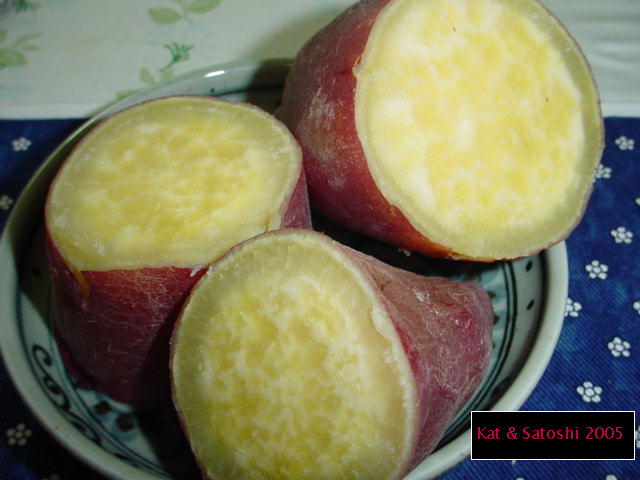
One food that is popular in Japan during autumn and winter is "yaki-imo" (roasted sweet potato). At night, you can hear the "yaki-imo" man (like the ice cream man in America), calling out to everyone over a loud speaker "ishi-yaki-imo". "Ishi-yaki" is to roast the potato on hot stones (kind of like when they roast a pig in the imu (roasting pit in the ground) in Hawaii) except the stones are in a metal container, like a barrel, many desserts during the autumn and winter here use sweet potato as fillings or toppings.

Naruto Kintoki is a sweet potato grown in Tokushima (Shikoku). Most sweet potatoes are known as "Satsuma-imo". "Satsuma" is the old name for the southern part of Kyushu. In the Edo period when the rice crops failed, a famine had swept over Japan. The government realized that the Satsuma area was the only area to survive the famine with little trouble because they were eating their sweet potatoes.

So, as a result, sweet potatoes were sent all over Japan as insurance against famine. Today, depending on the area, each has its own distinct name, shape and flavor.

Usually a sweet potato this size is rather expensive, but I got it for a little under $2. I steamed this guy in my steamer basket and had to have a piece of it when it came out....yummy!!

I think the reason they call this potato Naruto Kintoki is because Naruto is a city in Tokushima and Kintoki means a reddish color. And if you've ever seen Kintoki ninjin (Kintoki carrots) you'll realize that they are reddish colored carrots, not orange like regular carrots. And kintoki mame are red kidney beans.

In my last post entitled: sweets, I talked about ANA's new desserts. This is one of them, the caramelized pudding. I haven't tried either one yet, but will let you know when I do. :)