Showing posts with label namasu. Show all posts

Monday, November 01, 2021

kaki namasu

Another recipe I tried from Shirogohan...kaki namasu.

I like the idea of putting fruit into the namasu.

Hopefully I can find fresh kaki for new years, so I can put some into our namasu.

1/2 kaki, peeled then sliced into thin strips

1/4 daikon, peeled

1 carrot, peeled

1/2 teaspoon salt

Namasu marinade

6 tablespoons dashi (stock)

4 tablespoons vinegar

2.5 tablespoons sugar

Julienne daikon and carrot

Add salt and massage, set aside for 10 minutes

Mix sauce and stir until sugar dissolves

After 10 minutes squeeze out the water from the carrot and daikon

Pour the sauce over the veggies and add the sliced kaki

Mix well and chill before serving

NOTES: I used the food processor and shredded the daikon and carrot

I thought adding stock to the namasu marinade was different but it adds lots of flavor

Super easy to put together and tasty

I would definitely make this again.

Saturday, January 12, 2019

tataki gobo & namasu

I mentioned that I made namasu and tataki gobo for our osechi...these two are really easy to make.

Tataki Gobo adapted from Orange Page
1 "stick" gobo (burdock root) about 8-inches long, scrubbed and cut into half then into fourths.
water

1/4 cup dashi

A: 2 teaspoons sugar
1/2 tablespoon mirin
1/2 tablespoon shoyu

B: 1/2 tablespoon sugar
1/2 tablespoon shoyu
1/2 tablespoon sake
1/2 tablespoon vinegar

2 tablespoons ground sesame seeds

In a pot, put the gobo and water and when the water boils, turn down the heat to medium and cook for 10 minutes.
Take the gobo out then using a rolling pin (or something heavy), "roll" over the cooked gobo a couple of times (to break down the fibers).
Then put the gobo, dashi, and ingredients for "A" into a pot and cook on medium until the liquid evaporates.
After the liquid evaporates, coat the cooked gobo with "B" and the sesame seeds.

Namasu
4 inches wide daikon
4 inches long carrot
1/2 teaspoon salt
1 tablespoon sugar
1 tablespoon vinegar

Peel and shred daikon
Peel and shred carrot
Add 1/2 teaspoon salt and wait for 3 minutes.
After 3 minutes, squeeze out water from daikon and carrot
Put daikon and carrot into sugar vinegar mixture.

NOTES: after making this, I felt the daikon and carrot should be marinated separately then put together before serving to keep the white and orange colors separate.

If you try these, let me know what you think.

Monday, January 01, 2007

foodie new year!

It is the New Year here in Japan. I want to wish you all a Happy New Year! This year's Chinese astrological sign is the inoshishi (wild boar).

Unfortunately, Satoshi had to work today. It's not that he wanted to work on the first day of the New Year, but it is his turn to...plus, if you were on a trip and ran into some kind of trouble, you'd want someone to answer your call, right?

This morning we had ozoni. It is a traditional soup that most families have on the first morning of the New Year. I wrote more about this last year, if you'd like a re-cap, check it out here.

For lunch, I didn't feel much like cooking, especially since it was only for myself. But because many of the shops aren't open today, I decided to see what was in my freezer...I came up with croque monsieur--a very fancy name for a ham and cheese sandwich. I sliced some red onion and sauteed them in some butter, then put some butter into the frying pan and toasted both sides of the sandwich. Then I sprinkled cheese on top with some pepper and oregano and put the whole thing under the grill for 5 minutes. Having it with a bowl of cafe au lait made me feel like I was in Paris...


Dinner was our o-sechi (traditional dishes for the New Year). Our rice was a kamameshi type (rice cooked in an iron pot called a kama), with kuri (chestnut), kuromame (black beans) & gomoku (usually five ingredients--carrot, konnyaku (devil tongue jelly), sansai (wild mountain plants--warabi (fern shoots), zenmai (flowering royal fern)), takenoko (bamboo shoots). The rice is cooked with a shoyu (soy sauce) base which is put into the pot along with all these ingredients. Nowadays instead of having a kama (iron pot), you can cook this dish in your rice cooker.

We also had kohaku namasu (carrots and white turnip soaked in vinegar, sugar and mirin).


Kobumaki (rolled kelp), this dish is to bring yorokobu (happiness).

Tazukuri (dried anchovies), which prays for a good harvest.

Hinode cut kamaboko (fish cake cut to look like the sunrise). The fish cake is made in the celebratory colors of white and red.

Nasudengaku-roasted eggplant with a dengaku miso sauce. The miso sauce is a little sweet. I made the miso sauce with 80g red miso (soy bean paste), 1.5 T sugar, 2 T mirin (sweet rice wine) and 1/3 cup of kombu dashi (kelp stock). Since I roasted the eggplant and shiitakes in the oven, they came out a bit dry. I'll try cooking them in the frying pan again soon. This dish isn't part of the New Year celebratory foods, but I thought it would be a good dish to accompany all of our other dishes.

We toasted with a cup of sake (rice wine)--a limited edition ginjo (highly milled rice with or without alcohol added) called Manotsuru Tokimeki made by Obata brewery, from the island of Sado in Niigata prefecture.

During this time of year, you are supposed to warm up the sake, but I couldn't find my tokkuri (bottle to warm up the sake). So I decided to use my reishu (cold sake) ochoko (cups).

Cheers! Here's to a great start of a foodie new year!

Monday, December 04, 2006

never....

Note to self: NEVER, do more than two kitchen related tasks at the same time, especially in the teeny kitchen that you have...

I was baking bread while making dinner tonight...talk about praying to the kitchen remodeling gods to give me a bigger kitchen or at least a larger counter!

Anyway, here is the bread I made, flax seed rolls--hot out of the oven they were light and fluffy!

And dinner, my revenge attempt at okara hamburger patties. These came out really well this time. I realized the last time, that I had forgot to put in milk and put in too much okara.

So, here is the revised recipe: Okara Hamburger Patties Serves 2

150g minced pork or beef
100g okara (soy bean curd lees)
1/2 onion, minced
1 egg
2 tablespoons milk
salt & pepper to taste
1 tablespoon mirin (sweet rice wine)
1 tablespoon salad oil
1.5 tablespoons margarine
50 ml kombu dashi (kelp stock)

Sauce:
50 ml chuno sauce (a mixture of tonkatsu & worcestershire sauces)
3 tablespoons ketchup
2 tablespoons mirin (sweet rice wine)
1 tablespoon shoyu (soy sauce)
1 teaspoon sugar

1. Mince onion and put into bowl with meat and okara.
2. Add egg and milk, mix with hands.
3. Add salt and pepper.
4. Then add mirin and oil and mix well with hands.
5. Form into patties
6. Add margarine to heated pan and cook patties until golden brown.
7. Flip over and add stock to steam patties.
8. Add in sauce mixture and heat sauce with patties.
9. Enjoy!

NOTES: I don't buy margarine, so I used olive oil instead. Also, I used ground beef. I also used tonkatsu sauce (pork cutlet sauce) instead of chuno sauce (mixture of tonkatsu and worcestershire), if you can't find chuno or tonkatsu, use worcestershire. To top the patties I put some daikon oroshi (grated radish) with some chopped green onions.

I served them with some namasu (thinly sliced vegetables soaked in vinegar). The recipe is here.

NOTES: This time, I also added sliced cucumber and chopped wakame (a thin seaweed)

Hope your week is going well.

Monday, November 27, 2006

okara

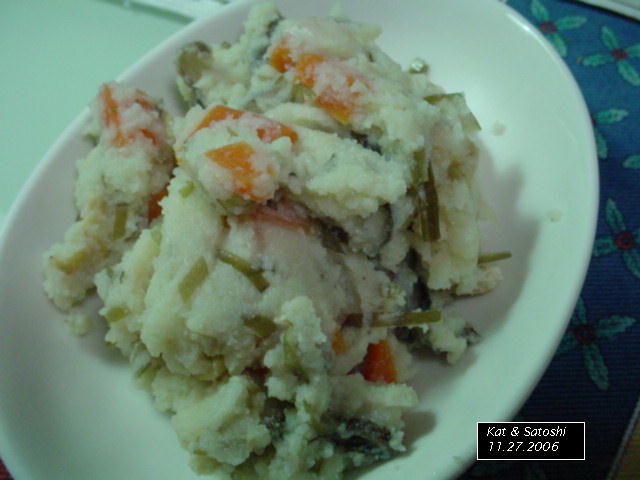
Okara or unohana are the lees of tofu (soy bean curd). It is a healthy way to eat protein without having to eat a lot of animal fat. I recently saw a show in which a dish using okara, as well as other dishes were prepared rather quick and easily.

Okara itame (soy bean lees stir-fry) serves 2
300 g okara
100g carrot
7 shiitake mushrooms
1 and 1/2 aburage (deep fried tofu pouch)
30g kombu (kelp)
350ml stock (preferably kelp stock)
2 tablespoon mirin (sweet rice wine)
2 tablespoon sake (rice wine)
2 teaspoons sugar
1 teaspoon oil

1. Put the okara into a frying pan and heat, then take out and leave aside.
2. Julienne the aburage, carrot, shiitake and kombu, leave aside.
3. In a pot, heat and add the oil and add the aburage, carrot, shiitake and kombu.
4. Coat everything with the oil and then add the stock, mirin and sake, cook until everything is soft.
5. Put the okara back into the frying pan and add the contents of the pot into the pan.
6. Cook on low heat until all the liquid disappears, stirring constantly.

The second dish was namasu (thinly sliced veggies soaked in vinegar).

Namasu serves 2
100g daikon (long white radish)
40g carrot
30g kombu (kelp)
70ml stock (preferably kelp stock)
50ml vinegar
50ml mirin (sweet rice wine)
2 teaspoons sugar

1. Julienne daikon, carrots and kelp.
2. In a bowl, place the daikon and carrots and sprinkle about 5g salt over and massage. Let sit for about 15 minutes.
3. Rinse and squeeze out all water.
4. Add kelp, stock, vinegar, mirin and sugar.

NOTES: if you make this ahead of time, it will be well soaked by the time you are ready to eat.

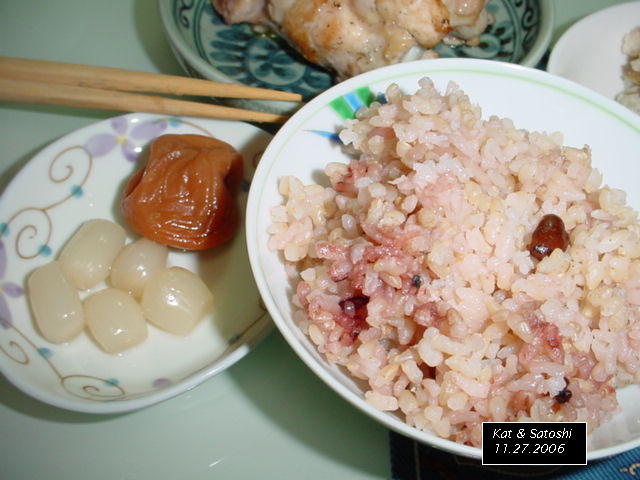
The last dish was pan fried chicken.

Pan fried chicken serves 2

6 pieces chicken wings
1 Tablespoon oil
1/5 teaspoon salt
pepper to taste
1 Tablespoon sake
1 Tablespoon shoyu (soy sauce)

1. In a frying pan, heat the oil and add the pieces of chicken.
2. Brown well, sprinkle the salt and pepper and lastly add the sake and shoyu.

NOTES: I finished cooking the chicken under the broiler for 10 minutes.

Make sure to serve this dinner with lots of rice and pickles like ume (pickled plum) and rakkyo (pickled shallots).

Enjoy!