Super easy (as long as you have the "okayu" (porridge) button on your rice cooker).
1/4 cup washed rice
600 milliliters water or dashi(stock) (3 cups)
1/2 teaspoon curry powder
1/4 onion, diced
1 small tomato, chopped
Cook on "okayu" mode.
NOTES: Next time, I would saute the onions before cooking them with the okayu. Also I would add the tomato before serving. We'll be having this again, especially when the temps get colder.
Kat & Satoshi's eating and traveling adventures around Japan (and sometimes Hawaii)
Showing posts with label okayu. Show all posts
Friday, September 14, 2018
Tuesday, January 23, 2018
hojicha okayu
Last year we tried Shimabara tea and enjoyed them.
Since I needed to pick up some hojicha (roasted green tea) for a recipe I wanted to try, I was pleased to see them in Umeda the other day.
This morning we had hojicha okayu.
Now that I think about it, it is similar to chagayu or chagai as my grandma used to call it, though I think my grandma used to use mugicha (barley tea).
Hojicha okayu : adapted from "Soup Stock Tokyo 2"
To make the stocks:
5 grams of loose leaf hojicha (roasted green tea)
1 cup water
1 dashi "tea bag"
4 cups water
Put 5 grams of hojicha in 1 cup of water, leave in refrig overnight.
Put 1 dashi "tea bag" in 4 cups of water (or the amount of water your bag instructs), leave in refrig overnight.
To make the okayu:
1 cup cold brew hojicha
2 cups cold brew dashi
1/4 cup rice, washed
toppings
In the rice cooker pot, put 1/4 cup washed rice and 1 cup of cold brew hojicha and 2 cups of cold brew dashi.
Cook on the "okayu" (porridge) setting on your rice cooker.
Serve with your favorite toppings.
NOTES: Since I didn't want to make 4 cups of hojicha dashi, I kept the hojicha separate.
When putting everything in the rice cooker, the cold brew hojicha was a little less than 1 cup, so I filled the difference with some water.
The hojicha flavor was quite pronounced.
I still need to try the actual recipe from the book I have, but at least I know now that it is relatively easy to put together.
I served this with some umeboshi and shiofuki konbu.
Oh and we've got cold temps back again after a brief "warm" spell last week.
Since I needed to pick up some hojicha (roasted green tea) for a recipe I wanted to try, I was pleased to see them in Umeda the other day.
This morning we had hojicha okayu.
Now that I think about it, it is similar to chagayu or chagai as my grandma used to call it, though I think my grandma used to use mugicha (barley tea).
Hojicha okayu : adapted from "Soup Stock Tokyo 2"
To make the stocks:
5 grams of loose leaf hojicha (roasted green tea)
1 cup water
1 dashi "tea bag"
4 cups water
Put 5 grams of hojicha in 1 cup of water, leave in refrig overnight.
Put 1 dashi "tea bag" in 4 cups of water (or the amount of water your bag instructs), leave in refrig overnight.
To make the okayu:
1 cup cold brew hojicha
2 cups cold brew dashi
1/4 cup rice, washed
toppings
In the rice cooker pot, put 1/4 cup washed rice and 1 cup of cold brew hojicha and 2 cups of cold brew dashi.
Cook on the "okayu" (porridge) setting on your rice cooker.
Serve with your favorite toppings.
NOTES: Since I didn't want to make 4 cups of hojicha dashi, I kept the hojicha separate.
When putting everything in the rice cooker, the cold brew hojicha was a little less than 1 cup, so I filled the difference with some water.
The hojicha flavor was quite pronounced.
I still need to try the actual recipe from the book I have, but at least I know now that it is relatively easy to put together.
I served this with some umeboshi and shiofuki konbu.
Oh and we've got cold temps back again after a brief "warm" spell last week.
Wednesday, January 10, 2018
dashi okayu
The other day we had our nanakusagayu for breakfast.
I've written about this before, here.
In the past, I would buy pouches of the ready made okayu, heat it up and then add the 7 grasses.
These days I make okayu in my rice cooker.
The other day, though, I added dashi (stock) to cook my okayu (rice porridge).
Okayu (rice porridge), makes about 2 servings (depending on the size of your bowls)
1/4 cup rice, washed
600 cc (about 3 cups) dashi or water
Cook in rice cooker on "okayu" mode.
NOTES: Satoshi and I agree okayu is much more flavorful cooked with dashi.
I think I may cook okayu this way from now on.
I like this consistency but if you don't like your okayu too watery, you can play around with the amount of water/dashi you use.
I've written about this before, here.
In the past, I would buy pouches of the ready made okayu, heat it up and then add the 7 grasses.
These days I make okayu in my rice cooker.
The other day, though, I added dashi (stock) to cook my okayu (rice porridge).
Okayu (rice porridge), makes about 2 servings (depending on the size of your bowls)
1/4 cup rice, washed
600 cc (about 3 cups) dashi or water
Cook in rice cooker on "okayu" mode.
NOTES: Satoshi and I agree okayu is much more flavorful cooked with dashi.
I think I may cook okayu this way from now on.
I like this consistency but if you don't like your okayu too watery, you can play around with the amount of water/dashi you use.
Tuesday, January 09, 2018
hojicha okayu
Saturday, I had breakfast at Soup Stock Tokyo and tried their hojicha okayu (roasted green tea rice porridge).
The tea flavor wasn't very detectable, but I enjoyed this.
I have their cookbooks and was happy to find that they have the recipe for this particular okayu.
Will try it as soon as I can get some of the ingredients together.
The tea flavor wasn't very detectable, but I enjoyed this.
I have their cookbooks and was happy to find that they have the recipe for this particular okayu.
Will try it as soon as I can get some of the ingredients together.
Monday, January 19, 2015
sunday dinner
Awhile back, I made mille feuille in my frying pan with a cover.
On a recent trip to visit MIL, I asked Satoshi to look for a donabe (clay pot) amongst her "stash".
She had several and Satoshi brought home this one made by Ginpo. These are made in Japan and are very sturdy (and heavy!). They hold heat well.
Last night we had mille feuille for our Sunday dinner, made in the donabe.
I had to adjust my recipe because this pot holds more liquid.
Instead of 1.5 cups of water, I used 6 cups. The flavors were a lot lighter but since Satoshi is watching his sodium, it was just right.
We had this with beer.
And at the end, I re-heated the soup, added some rice and egg to make a dish called Ojiya (which is also known as Zosui--a porridge of rice and veggies).
You might be wondering what the difference between zosui/ojiya and okayu is? Well, Okayu is just the porridge of rice (plain, if you will). Zosui/ojiya is a rice porridge that is seasoned with condiments like miso, shoyu or salt.
Dinner was easy to put together and I can see why lots of families like to make this during the winter.
I think we'll try other dishes in this donabe (clay pot) for our Sunday dinners in the coming weeks.
Have a nice week!
On a recent trip to visit MIL, I asked Satoshi to look for a donabe (clay pot) amongst her "stash".
She had several and Satoshi brought home this one made by Ginpo. These are made in Japan and are very sturdy (and heavy!). They hold heat well.
Last night we had mille feuille for our Sunday dinner, made in the donabe.
I had to adjust my recipe because this pot holds more liquid.
Instead of 1.5 cups of water, I used 6 cups. The flavors were a lot lighter but since Satoshi is watching his sodium, it was just right.
We had this with beer.
And at the end, I re-heated the soup, added some rice and egg to make a dish called Ojiya (which is also known as Zosui--a porridge of rice and veggies).
You might be wondering what the difference between zosui/ojiya and okayu is? Well, Okayu is just the porridge of rice (plain, if you will). Zosui/ojiya is a rice porridge that is seasoned with condiments like miso, shoyu or salt.
Dinner was easy to put together and I can see why lots of families like to make this during the winter.
I think we'll try other dishes in this donabe (clay pot) for our Sunday dinners in the coming weeks.
Have a nice week!
Tuesday, January 07, 2014
nanakusagayu
Today is the 7th of January which means we eat nanakusagayu.
This year I almost forgot about making this. Luckily, when I went to the market yesterday they had the nanakusa (7-grass) sets on display.
I hope this year we'll all be healthy and happy.
This year I almost forgot about making this. Luckily, when I went to the market yesterday they had the nanakusa (7-grass) sets on display.
I hope this year we'll all be healthy and happy.
Saturday, January 07, 2012
harnn
I've written about Harnn soaps before, here.
Satoshi recently received this rosemary & artemisia bar. I had to look up what artemisia was, apparently it is part of the daisy family.
The packaging changed a bit from the time I picked some up, the rosemary fragrance is quite strong, can't wait to use it.
Since today is the 7th, we're having our nanakusagayu today.
This weekend is also a 3-day weekend, but Satoshi has to work today.
Satoshi recently received this rosemary & artemisia bar. I had to look up what artemisia was, apparently it is part of the daisy family.
The packaging changed a bit from the time I picked some up, the rosemary fragrance is quite strong, can't wait to use it.
Since today is the 7th, we're having our nanakusagayu today.
This weekend is also a 3-day weekend, but Satoshi has to work today.
Friday, January 07, 2011
icy friday
Not enough to stay frozen but still snow.
In fact, while I walked in the morning, there was a little hail storm.
Even after living here for 9 years, seeing flurries or "snow" still gets me hyped.
It was good, smoky sausage with a nice snap. Diced jalapenos, carrots & some lettuce all on a chewy baguette...yum!
The weather tonight is supposed to drop to -1C (30F)...I am secretly hoping there will be more snow.
Have a nice weekend!
Thursday, January 06, 2011
this and that
If you like Snickers and Peanut Butter, you will enjoy this.
There are two squares in a package...yummy. (It says you can save the other square for later, but I ate them both in one sitting...)
This time around I used a can of whole tomatoes, but the sauce was still a little sweet, so I should definitely cut the sugar back the next time.
The week flew by and we have a holiday coming Monday...ooh and tomorrow is the day to eat Nanakusagayu.
Thursday, January 07, 2010
it's that time of year
Since we don't have a car, we caught the bus, it is about 15 minutes by bus to Xiao Long Bao (or as the Japanese pronounce it shorompo).
The buffet is not your usual, self-serve, but you order what you want off a menu and they bring it to you.
This is a great system, not only is there little waste of food, but they can actually control the amount you eat.
When you order, you are given a check sheet, you can only order 10 dishes at one time.
When the food comes out, you cannot order any more food until you finish what you've received.
The dim sum and desserts order with two pieces, but you could increase the number if you wanted to.
If you come by yourself, you won't be able to eat from the buffet (how discriminating is that?), you will only be able to order the prix fixe menus (which the Japanese call "set menu").
Despite all the rules, we were able to try 19 different items from the 50 item list.
I loved the mabo tofu and goma dango (jin dui filled with sweet bean paste). I also ordered the coconut dango and was surprised as it was a custard inside and the outside was coated with shredded coconut, not the jin dui filled with coconut.
For the two of us it was 2400 yen (about US$24), we had a coupon for free drinks so we were able to get two cups of oolong tea (wished they served this hot rather than over ice!)
The biggest disappointment was that you couldn't get xiao long bao from the buffet, only if you ordered a prix fixe menu, guess it is kind of expensive to put on the buffet.
I guess if we had a car, we would probably go back to try their dinner buffet, but since we don't, I don't think we'll be back.
Xiao Long Bao
1-2-2 Aoshinke
Minoo, Osaka
Phone: 072.726.3498
In the markets, you will see packages of these grasses.
I've labeled them as best as I could, hope it is correct.
Since I do not have much time in the morning, I usually prep this the night before.
After cleaning them, I cook the radish and turnip for about 5 minutes in boiling water. Then I blanche the greens.
I chop all the greens quite fine, and do the same for the turnip and radish.
In the morning, I heat up the okayu (rice gruel), heat up the grasses and then put them together.
We usually eat them with tamagoyaki (rolled omlette), tsukemono (pickled veggies), mikan (tangerine) and green tea.
Though I'm getting over a cold, here's hoping that the rest of this year will be a healthy one.
Have a great day!
Thursday, January 08, 2009
tempura tenya
Yesterday was the 7th, which means it was nanakusagayu day for us. My blog friend, Martin, recently wrote an article about nanakusagayu and mentioned us (Thank you!).
If you are interested, I have also posted about nanakusagayu here and here.
Satoshi had the day off yesterday, so after our breakfast of nanakusakayu, tsukemono (pickles) and tea, we watched some of the shows we recorded over the New Years break and walked to a nearby area for lunch.
Tempura Tenya is a tempura shop located in a house about 15 minutes walking distance from our house. (I actually found this place by accident one day while on one of my walks, then googled around to find out more info.)
The young couple who own the shop, uses vegetables from Japan to create crispy, delicious tempura as well as side dishes and tsukemono (pickles).
We both ordered the lunch set, 1350 yen each(about US$13.50) which comes with one side dish, miso soup with lots of veggies in it, 3 choices of seafood tempura, 4 choices of vegetable tempura, rice and tsukemono (pickles).

I chose ebi (shrimp), tako (octopus), hotate (scallop), nasu (eggplant), kabocha (pumpkin), renkon (lotus root) and gobo (burdock).
Satoshi chose ebi (shrimp), mongo ika geso (large sized cuttlefish leg), kisu (sillago, Japanese whiting), nasu (eggplant), tamanegi (yellow onion), shironegi (scallion) and eringi (a type of mushroom).
After ordering, they brought out several side dishes from which we could choose one. Satoshi chose a marinated eggplant and I chose a salad made from vegetables and bi-fun.
Then a big bowl of miso soup filled with lots of veggies came out with some tsukemono (pickled veggies).

Tempura came out as soon as it was ready, so it was hot, crispy and delicious. The one thing I noticed was that when our bowls of rice came out, mine was really small and Satoshi's really big. At first, I was kind of shocked, but after eating most of my lunch, it ended up where I didn't really need much rice after all and ended up giving some to Satoshi (who by then already had a second bowl of rice!)
In Japan, a lot of shops serve flavored salts as well as tsuyu (dipping sauce) with their tempura. This shop had yuzu shio (citron salt), sansho shio (Japanese pepper salt) and matcha shio (green tea salt).
It was a nice lunch and we were full, so we took the long way home.
Tempura Tenya
5-6-27 Sakuragaoka
Minoo, Osaka
Phone: 072.725.5040
Closed 1st & 3rd Thursdays
If you are interested, I have also posted about nanakusagayu here and here.
Satoshi had the day off yesterday, so after our breakfast of nanakusakayu, tsukemono (pickles) and tea, we watched some of the shows we recorded over the New Years break and walked to a nearby area for lunch.
Tempura Tenya is a tempura shop located in a house about 15 minutes walking distance from our house. (I actually found this place by accident one day while on one of my walks, then googled around to find out more info.)The young couple who own the shop, uses vegetables from Japan to create crispy, delicious tempura as well as side dishes and tsukemono (pickles).
We both ordered the lunch set, 1350 yen each(about US$13.50) which comes with one side dish, miso soup with lots of veggies in it, 3 choices of seafood tempura, 4 choices of vegetable tempura, rice and tsukemono (pickles).

I chose ebi (shrimp), tako (octopus), hotate (scallop), nasu (eggplant), kabocha (pumpkin), renkon (lotus root) and gobo (burdock).
Satoshi chose ebi (shrimp), mongo ika geso (large sized cuttlefish leg), kisu (sillago, Japanese whiting), nasu (eggplant), tamanegi (yellow onion), shironegi (scallion) and eringi (a type of mushroom).
After ordering, they brought out several side dishes from which we could choose one. Satoshi chose a marinated eggplant and I chose a salad made from vegetables and bi-fun.
Then a big bowl of miso soup filled with lots of veggies came out with some tsukemono (pickled veggies).

Tempura came out as soon as it was ready, so it was hot, crispy and delicious. The one thing I noticed was that when our bowls of rice came out, mine was really small and Satoshi's really big. At first, I was kind of shocked, but after eating most of my lunch, it ended up where I didn't really need much rice after all and ended up giving some to Satoshi (who by then already had a second bowl of rice!)
It was a nice lunch and we were full, so we took the long way home.
Tempura Tenya
5-6-27 Sakuragaoka
Minoo, Osaka
Phone: 072.725.5040
Closed 1st & 3rd Thursdays
Monday, January 07, 2008
nanakusakayu
It's that time of year in Japan for us to eat our Nanakusakayu which I've posted about previously.I've always bought the o-kayu (rice porridge) pre-made in ready to boil bags, but this year forgot to buy some, so I ended up making it in my rice cooker.
I made 2 cups of rice, not realizing that 2 cups makes a LOT...sigh. Eating Nanakusakyu not only is a way for the Japanese to hope for a healthy year, but it is also a good way to ease your stomach after eating rich foods during the New Year holidays.
Most of the Nanakusa was eaten today, but there is still lots of o-kayu. Guess we'll be having a variation of this for the next couple of breakfasts.
Have a nice week!
Monday, July 24, 2006
trying to beat the heat (part 3)
We've been having rain and humidity...ugh! But have been fortunate not to have had the flooding and landslides as Kyushu did over the weekend.
I've been trying at all costs to find ways to avoid standing near the stove. Here's what I've come up with...

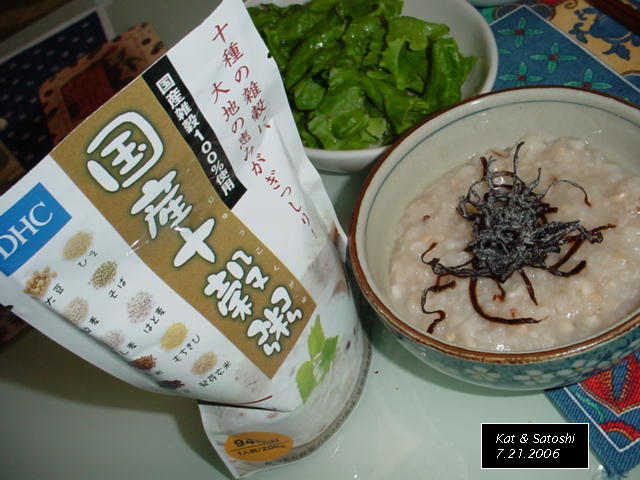
An instant okayu (gruel) made with 10 different grains made by DHC. This company is also in the U.S. and has a wonderful skin care line. It is kind of like oatmeal and appears a lot as a breakfast item--except in Japan, we top okayu with nori, tsukemono (pickled veggies) and pair it with grilled fish. Just stick this bag into a pot of boiling water for 5 minutes and you have part of your meal! Okay, it is instant, but at least you only need to stay near the stove for 5 minutes...
Furofuki daikon (well boiled turnip, is the definition in my book, but I think it has more imagery of bathing since the Chinese characters for this dish are for bath--furo). This dish is really easy to make.
Slice your turnip into 4 cm. slices and make a cross at the top (be sure not to go all the way through). This is to let the stock soak through and it makes it easy to eat with chopsticks.
Next, get some kombu (kelp) and fish shavings, like bonito and soak in boiling water for about 30 minutes until your stock is formed. Add your sliced turnip. Add 1 tsp. shoyu (soy sauce) and 1 tsp. mirin (sweet rice wine) and boil everything until soft (about an hour).
The next step is the only one which you need to stand near the stove (10-15 minutes tops!)....The sauce on the top is a miso (soy bean paste) base. Put 5 tbsp. of miso, 3 tbsp. of sugar, 2 tbsp. of sake (rice wine) and 2 tbsp. of mirin (sweet rice wine) into a small pot or pan and stir on low heat, with a wooden spoon until smooth--be sure not to burn the sauce!
Store leftover turnip separately from the miso sauce.
Enjoy!
I've been trying at all costs to find ways to avoid standing near the stove. Here's what I've come up with...

An instant okayu (gruel) made with 10 different grains made by DHC. This company is also in the U.S. and has a wonderful skin care line. It is kind of like oatmeal and appears a lot as a breakfast item--except in Japan, we top okayu with nori, tsukemono (pickled veggies) and pair it with grilled fish. Just stick this bag into a pot of boiling water for 5 minutes and you have part of your meal! Okay, it is instant, but at least you only need to stay near the stove for 5 minutes...
Furofuki daikon (well boiled turnip, is the definition in my book, but I think it has more imagery of bathing since the Chinese characters for this dish are for bath--furo). This dish is really easy to make.Slice your turnip into 4 cm. slices and make a cross at the top (be sure not to go all the way through). This is to let the stock soak through and it makes it easy to eat with chopsticks.
Next, get some kombu (kelp) and fish shavings, like bonito and soak in boiling water for about 30 minutes until your stock is formed. Add your sliced turnip. Add 1 tsp. shoyu (soy sauce) and 1 tsp. mirin (sweet rice wine) and boil everything until soft (about an hour).
The next step is the only one which you need to stand near the stove (10-15 minutes tops!)....The sauce on the top is a miso (soy bean paste) base. Put 5 tbsp. of miso, 3 tbsp. of sugar, 2 tbsp. of sake (rice wine) and 2 tbsp. of mirin (sweet rice wine) into a small pot or pan and stir on low heat, with a wooden spoon until smooth--be sure not to burn the sauce!
Store leftover turnip separately from the miso sauce.
Enjoy!
Saturday, January 07, 2006
nanakusagayu
According to the weather people, in the past twenty years, this winter has been the worst. A record snowfall is hampering many areas along the Japan Sea Coast. One area has had over 340cm. (11 ft.) within the last month! Being from Hawaii, snow is quite a novelty, but snow to that degree is a bit frightening. For one, I don't have the correct shoes, so slipping on the snow is very dangerous.
Today is the 7th of January. It is a significant day because you eat a rice porridge (o-kayu)with 7 different grasses in it as a way to wish for good health throughout the year called Haru no Nanakusagayu. (Haru no= Spring's, Nana = 7, kusa = grasses, kayu = rice porridge).
In the olden days of Japan, they thought that birds from China brought diseases with them to Japan, so in order to ward off these diseases, they ate this porridge. I think they made the day to eat the porridge on the 7th because it is the first 7th day of the year (01/07) = January 7th (easy to remember??), plus it is the 7-grasses porridge...hmm.
The 7 grasses are: seri (parsley), nazuna (shepard's purse), gokyou (cotton weed), hakobera (chickweed), hotokenoza (like dandelion), suzuna (like turnip), and suzushiro (like radish).
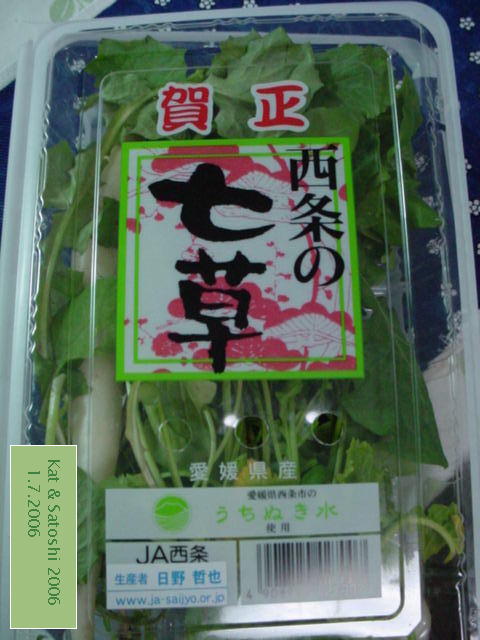
<---It comes in a package like this. You wash all the grasses and parboil until the leaves wilt. Then chop up and add to your porridge. The porridge has the consistency of oatmeal, but you could make your porridge more liquidy if you like. It tastes like you added spinach to your un-sweetened oatmeal.
There is also Natsu no Nanakusa (Summer's 7 grasses), Aki no Nanakusa (Autumn's 7 grasses) and Fuyu no Nanakusa. During these seasons, the grasses aren't put into a porridge, instead they are used in flower arrangements.
I served our porridge with some leftover salmon patties.
Today is the 7th of January. It is a significant day because you eat a rice porridge (o-kayu)with 7 different grasses in it as a way to wish for good health throughout the year called Haru no Nanakusagayu. (Haru no= Spring's, Nana = 7, kusa = grasses, kayu = rice porridge).
In the olden days of Japan, they thought that birds from China brought diseases with them to Japan, so in order to ward off these diseases, they ate this porridge. I think they made the day to eat the porridge on the 7th because it is the first 7th day of the year (01/07) = January 7th (easy to remember??), plus it is the 7-grasses porridge...hmm.
The 7 grasses are: seri (parsley), nazuna (shepard's purse), gokyou (cotton weed), hakobera (chickweed), hotokenoza (like dandelion), suzuna (like turnip), and suzushiro (like radish).
<---It comes in a package like this. You wash all the grasses and parboil until the leaves wilt. Then chop up and add to your porridge. The porridge has the consistency of oatmeal, but you could make your porridge more liquidy if you like. It tastes like you added spinach to your un-sweetened oatmeal.There is also Natsu no Nanakusa (Summer's 7 grasses), Aki no Nanakusa (Autumn's 7 grasses) and Fuyu no Nanakusa. During these seasons, the grasses aren't put into a porridge, instead they are used in flower arrangements.
I served our porridge with some leftover salmon patties.
Subscribe to:
Posts (Atom)