Tuesday, March 14, 2006

white day

It's nearly the middle of March and we have gone back in time. The weatherforecasters are saying that the temperatures are that of mid-winter...um, well, the snow flurries that we had for most of yesterday would do it, don't you think?

One thing I forgot to mention about Okinawa is that they are known to have the longest life expectancy. This is due to their diet which consists of lots of veggies, fish, pork and their lifestyle.

About 3 years ago, when Satoshi was helping me search for my roots, I read "the Okinawan Program". Although this book is very thick, it was filled with lots of interesting facts and information about the Okinawan culture. Being able to connect with relatives in Okinawa was a dream come true! There were cousins as old as my father and many stories were told. Although there were some areas that are still mysteries, it was nice to be able to find family.

While living in Japan, Satoshi has not only helped me connect with my Okinawan relatives on my father's side, but with relatives on my mother's side. Her side of the family includes stories about immigrating to Hawaii, picture bride marriage, life during the war and a family tree that goes back to the Edo period. I've been able to write up our family trees from the info that family members have given me. And to be able to have a written record of things has been a good learning experience. If you have the chance to find out about your roots, especially from the elders in your family, I truly recommend either using a tape recorder or taking notes, because once these elders pass, there is no way to recover what they know or have experienced.

Changing the subject, today is White Day in Japan. This is the day when the GUYS give the girls something in return for Valentine's Day. Satoshi gave me my ticket to Hawaii and some Australian soaps. I usually go back to Hawaii once a year, usually for two or three months, usually during most of winter. This year is a bit different, I'll only be going home for a month. Although it won't be as long as the times I've gone home in the past, I'm still thankful to be able to go. (Thanks Satoshi!)

During the winter in Japan, the main local citrus fruit that you see is called mikan. I think it is a type of tangerine. The skin is very thin, there are no seeds and it is easy to peel. Recently, I've seen more citrus fruits being brought into the markets. One is the kiyomi orange which we had with breakfast. This orange grows in the Wakayama prefecture. The skin is very soft and there is hardly any membrane sacs, mostly all "orange" and really juicy! If you get a chance to try this one, it is really good!

Monday, March 13, 2006

okinawa (day 3)

Day 3 started off really early. We left our hotel at 8 am...our first stop was Himeyuri no to. This is a memorial in the Itoman area where 200 school girls committed suicide rather than be captured by the Americans during the war. Here we said a prayer.

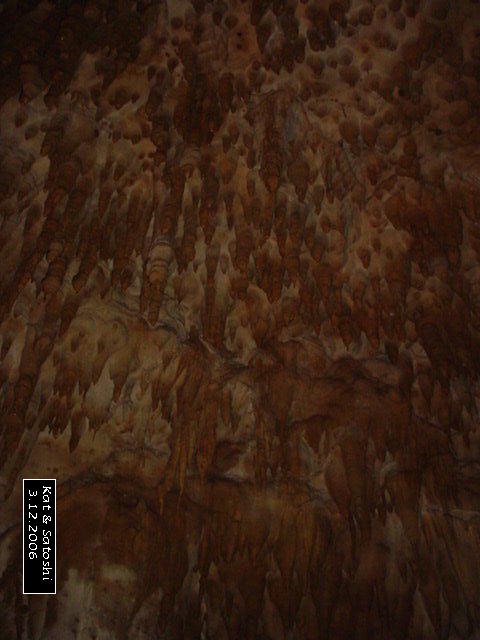
We then went to Okinawa World. This is a park with a very l-o-n-g cave called gyokusendo. Inside the cave are stalactite and stalagmite over 300,000 years old.

And then we were off to Kokusai-dori for lunch. I had So-ki soba (this is Okinawa's soba (like udon (wheat noodles) with spareribs with soup). Satoshi had Okinawa soba (slices of su-chika-(pork shoulder cooked in salt and stock until soft) on Okinawa's soba with soup).

Some interesting sites: Ishiganto, these are good luck rocks placed in front of homes.

Akagawara (red tile roofing), found on most traditional homes in Okinawa.

Face of a shisa (lion) at the Churaumi Aquarium.

One place to visit is the farmer's market, just off Kokusai-dori. A lively area with lots of vegetables, fruits, pork and fish. A lot of vendors weren't open on Sunday, but I was able to get a photo of a pork vendor. Okinawan don't eat much beef except for Ishigaki beef, they mainly eat pork, chicken and fish.

A basket of Okinawan vegetables near the buffet at Mahaina: from the top clockwise, pumpkin, ginger root, green papaya, beni-imo (purple sweet potato), beni-jagaimo (red potato), onions.

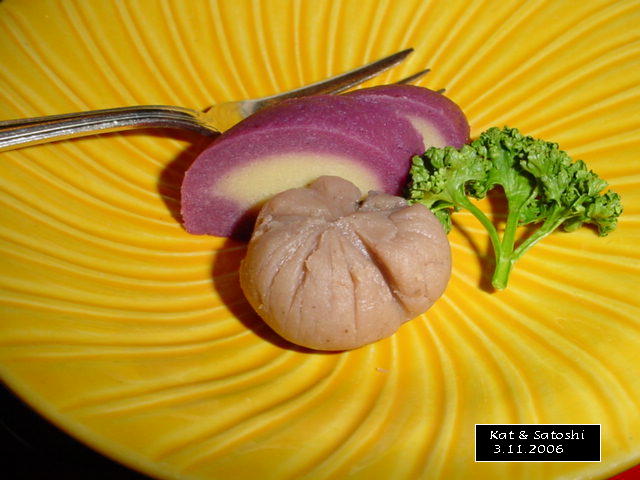
Dessert with dinner at the Okinawa Miyako hotel. Beni-imo kintoki (mashed and sweetened purple sweet potato) and kuri-kinton with black bean (mashed and sweetened chestnuts with black bean in the middle)

We made it safely back to Osaka and Satoshi's parents had a nice time. We're back to the cold weather, in fact, we had some flurries this morning! (isn't it March??)

Hope you enjoyed this journey as much as we did!

okinawa (day 2-pm)

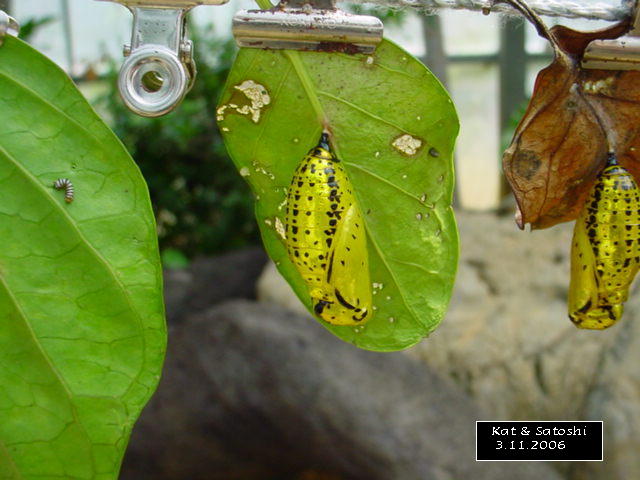
The next stop was Fruitland. This park had all kinds of fruit trees found in Okinawa. Most were similar to those seen in Hawaii. I also saw the vanilla plant and was surprised at they way it is grown. It looked like green beans on a vine. There was also an area with exotic birds and butterflies. The oogomadara butterflies cocoon (sanagi) is golden.


We made a short stop at Manzamo. Manzamo is a cliff area looking out over Manza Bay. During the war, many Okinawans jumped from this cliff to their deaths for fear of being captured by the Americans.

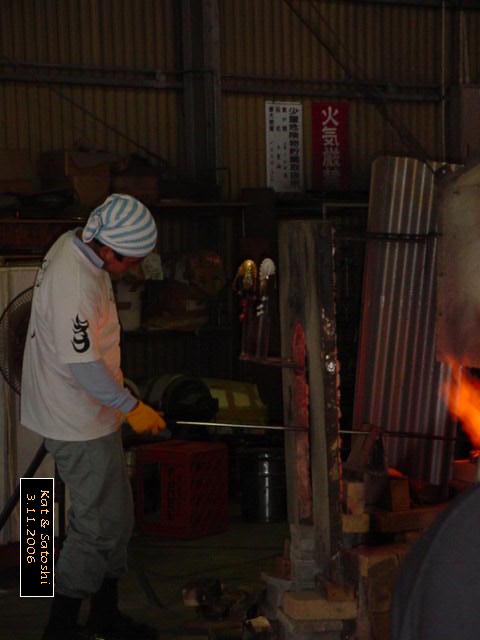
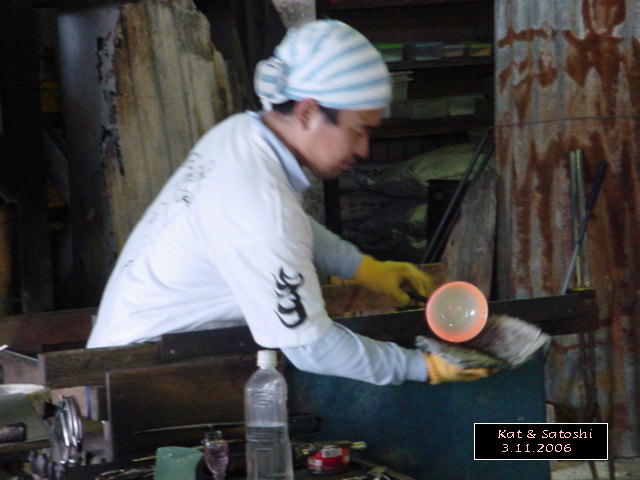
The next stop was Mori no glass kan, it is a work area where glass craftsmen blow glass and make different glass items such as cups, bowls, dishes and other interesting items. First the craftsman heats the glass in a large flame, then shapes the glass while it is still hot. After the desired shape is reached, he gently taps it off from the pole, then puts the piece into another kiln like oven to set.

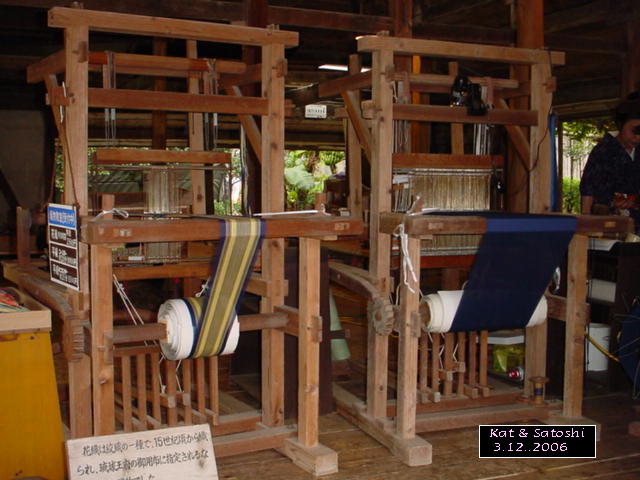
Ryukyumura (Ryukyu is another name for Okinawa) this park has a little village of traditional Okinawan homes where you can try different crafts such as weaving.

Dress up in the traditional costume (the big hat is called hanagasa). My in-laws.

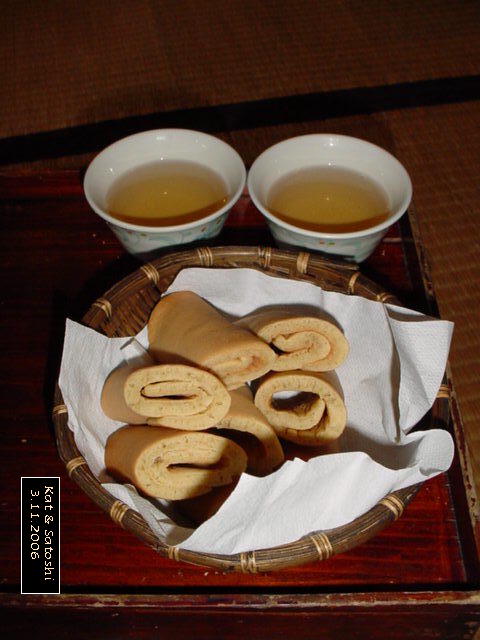
Enjoy tea with po-po (Okinawan crepe made with kokuto (black sugar) and flour).

When you visit an Okinawan home, you'll see their family altar. It is this huge thing (on the right with the bottle of awamori (Okinawan sake (rice wine)) in front) that looks like a cupboard.

And see a traditional performance of eisa. Eisa, is a powerful and dynamic Okinawan dance performed with taiko (drum). This dance is usually performed for ancestors during the Lunar Bon Holiday. Eisa means to chant from a Buddhist prayer.

After a long day of sights, we then checked into our hotel, the Okinawa Miyako Hotel. This hotel is just down the hill from Shuri-jo (Shuri Castle). And 10 minutes from Kokusai-dori (International street). Kokusai-dori is a street filled with tiny shops and restaurants a great place to shop.

Okinawa Miyako Hotel
40 Aza Matsugawa
Naha, Okinawa
Phone: 098-887-1111

okinawa (day 2-am)

Day 2 started with a buffet breakfast. Taro imo (like sato-imo, sometimes called dasheen) a thick potato soup with corn, cubed aloe with shi-quasa (sometimes called hirami lemon, is like a mix between a lime, lemon and orange), salad with goya (bittermelon), okinawan carrots, spam, egg, weiners made with ukon (tumeric), fried taro imo and beni-jagaimo, papayairichi(green papaya stirfried with chives and carrots).

We then went to the Churaumi Aquarium. Chura means beautiful in Okinawan and umi means ocean in Japanese. This aquarium is big! and has 3 jinbeizame (whale sharks). There were a lot of tropical fish and also some fish that we see in Hawaii fish markets. There were also some species that I've never seen before, like these chinanago (garden eels)--(eew sea worms!!)

Our next stop was the Yanbaru Anettaien, this garden area has a rainforest atmosphere with hego (fern) that are over 10 ft tall!

Lunch was Okinawan style bibimba (rice with Okinawan vegetables cooked in a stone bowl). Bibimba is actually a Korean dish. And aloe sashimi (sliced aloe). Aloe is quite bitter, but tasted good with a splash of lemon and soy sauce.

There was an area where you could try your hand at making chinsuko (Okinawan shortbread) and andagi (Okinawan donuts), I didn't get to try this but the man who was frying them gave me a free one to eat!

Blue Seal ice cream is also very popular in Okinawa. The American name is Foremost. I had Mint chocolate chip (since I can't find this flavor in Japan, not even at Haagen Datz) and Satoshi had beni-imo (red sweet potato).

okinawa (day 1)


3 days in Okinawa. The temperature was 24C (75F) during the daytime. We saw a lot of sights and ATE a LOT of food...

Our first day, started with spam musubi at the Naha airport. Our flight was during lunchtime so we didn't have much time for lunch. For most people in America, spam is looked down upon as "poor people" food. In Hawaii and in Okinawa, spam can definitely be found in most family's pantries. In Hawaii, you can get spam with eggs and rice for breakfast and can find spam musubi in the convenience stores. It is a good finger food especially when travelling. In Okinawa, they call spam musubi, pork tamago nigiri (spam, egg rice ball). These musubi are huge and had tsukudani (sweetly seasoned seaweed) inside. Each family whether in Okinawa or Hawaii has their own original way to make this musubi.

Our first sight seeing stop was Shuri-jo (Shuri Castle). This castle is modeled after a castle in China. One thing you will notice is that there are a LOT of Chinese influences in Okinawa. In the Shuri-jo bathroom, there were shisa faucets. The shisa is a lion-like figure that is usually found at the entrances of Okinawan homes. The shisa on the right will usually have its mouth open. This symbolizes the male who is protecting the home. The shisa on the left will usually have its mouth closed. This symbolizes the female who "grabs" onto happiness and doesn't let it go. Since it is spring in Okinawa, there were lots of flowers, this was an area with a lot of impatiens.

Our next stop was Okashigoten, a large factory which makes a lot of Okinawan cookies and sweets. One item that they sold were andagi. Andagi is the Okinawan donut. These donuts are fried but no sugar is put on the outside. We tried 3 different kinds (From left clockwise: kokuto (black sugar), goma (sesame) and plain). Many Okinawan families have their own original recipes.

We then went to check-in at our hotel, Mahaina Wellness Resort. The word mahaina is a cut and paste of different chinese character meanings: ma (the best state of something), hai (south), na (wave). It was thought that most explorers came to find their new lands on the "best south waves". Dinner was a buffet. Warning: if you go to most buffets in Japan, be prepared to be pushed around by other customers and have them cut in line to take their food...
Here's my first round: pink container (nigana tofu, bean curd with bitter leaves) rice with radish soaked in ukon (tumeric) and radish soaked in acerola (not pictured), on plate: from left clockwise, goya champuru (bittermelon with egg and tofu stir-fry), ku-buirichi (konbu (seaweed) stir fried with carrots and pork, vegetable salad with okinawan carrots, radish and umi-budo (which are these little salty roe-like seaweed that resembles tiny grapes), papaya-irichi (green papaya stirfried with pork, carrots and chives), naberanbushi (hechima (loofah gourd) stewed with chicken and miso (soy bean paste)), so-ki (pork ribs stewed in seasonings until the meat falls off the bone).
My second round from top clockwise: beni-jagaimo (red potato), somin champuru (stir-fry with somen (like cappelini) and goya (bittermelon), coconut cookie, coconut tart, goya champuru and so-ki.

Mahaina Wellness Resort
1456 Yamakawa
Motobu-cho, Kunigami-gun, Okinawa
Phone: 0980-51-7700

Thursday, March 09, 2006

crochet

Today was my bead crochet class. We made a 3-layer dome ring. It took the whole 2 hours! I'm pretty pleased with how it came out. (Sorry the photo is a bit dark and green...)

This weekend we're off to Okinawa. It is my mother-in-law's 77th birthday. She's wanted to go to Okinawa not only to see the sights, but also to take a photo in the traditional costume.

In Japan, the 77th birthday is called kiju. The chinese characters for kiju means "joyous year", in the early days for someone to live to the age of 77 was definitely fortunate. There are other interesting meanings for different years.

One is at 60 years, it is called kanreki. It is thought to be the second birth of the person. The calendar was based on the chinese characters and the lunar system and was organized on a 60-year cycle, so it is thought that life returns to its starting point at the 60th year. At the 60th celebration, the guest of honor wears a red vest and red cap. These symbolize the clothes worn by babies and the return to his/her birth.

80 years is called sanju, 88 is called beiju, 90 is called sotsuju and 99 is called hakuju.

Beiju is written with the character for rice. Rice was respected by everyone not only as a staple but also a symbol of their livelihood and happiness. A fundamental part of Japanese society, rice also symbolizes purity and goodness. The 88th birthday is celebrated as a very happy and joyous occasion.

Have a nice weekend!!

Wednesday, March 08, 2006

registered alien

Today I had to go to pick up my gaikokujintoroku (foreigner's card) or as they have it on the top of the card, "certificate of alien registration" (do we call foreigners in America, aliens too?). I was kind of excited to get a new card, because it meant a new photo. The first time I applied for this card was 5 years ago. I took the photo on my own, by going into a box which takes photos for various applications (passports, college applications, resumes. Can you believe you have to put your picture on your resume?). This time, I went to a photo shop in the shotengai (shopping arcade) where we live, the thing is you aren't allowed to smile. I don't know why...so, now I'm stuck with a mad looking photo for the next 5 years...oh, well, at least I have the card, right?

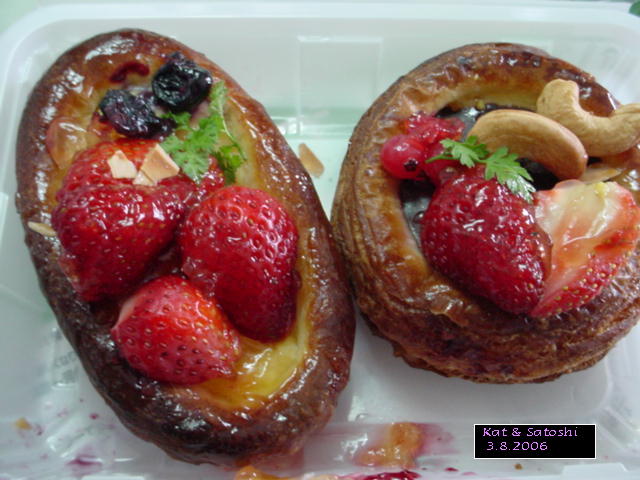
On my way to the city office, I looked forward to going to my favorite bake shop, Abientot. They had all kinds of breads. I bought a croque-monsieur. It is a ham sandwich which is grilled, it had a bechamel sauce, ham and broccoli on top. Also, an eggplant, bacon pizza. And strawberry brioche & strawberry ganache. The brioche and ganache had custard cream inside and strawberries and fruits on top. Everything was very good!

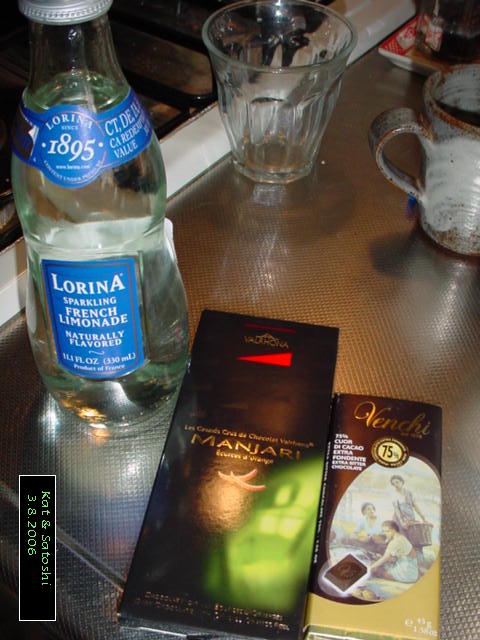
Another thing I looked forward to was roaming the aisles of the gourmet supermarket. It is on the way from the city office to the train station. I found some interesting food things. I remembered on Bea's blog that she talked about Lorina drinks. This sparkling drink is from France. I bought the Sparkling Natural Limonade. Valrhona's Manjari, also from France. A dark chocolate with orange peel. And Venchi, an Italian Dark Chocolate.

So now I'm a registered alien with lots of good food.