
I had a small amount of anko (sweet bean paste) that needed using up.
Some cherry trees have started blooming.
We've been having nice temps but are heading for a cold snap tomorrow.
How is the weather where you are?
 Awhile back, I had this bread. Since it was World Bread Day yesterday and since I had some leftover sweet potato from making gnocchi and some leftover an from making anpan...I tried to re-create it. I used the bread recipe that I always use, but didn't have enough filling. And for some reason, these guys came out HUGE and I weighed them as I was dividing the dough! The bread I had tried before was harder, more like a country-style bread. Still, with the slightly sweet potato and the sweet bean paste, it made a great snack.
 Remember I made rafute and told you that Satoshi doesn't like it? Well, I fessed up to using his awamori and told him, " I made rafute, but since you don't like it, I didn't save you any." He quickly said, "But, I like rafute!"
 So, I made some last night, I couldn't find pork belly and ended up buying the thigh portion instead which had less fat. For dinner we had rafute don (braised pork belly bowl), Satoshi bit into the pork and said, "ooh, what kind of fish is this?".....
 Okay....so Satoshi's breakfast was shiru soba (soup noodle). This dish uses the stock from the boiled pork (remember I threw it out the last time?). Here is an adapted recipe from "Shiawase no Okinawa Ryori":
 Since the nights and mornings are kind of nippy, I figured I should protect all my plants that don't appreciate the cold, namely tomato, basil, strawberry and italian parsley. I bought these plastic sheets from the 100 yen store ($1 store). It is actually a cover for your a/c but I made it into a "hot house", there were 2 in a package, so it only cost about $.50 to make each one! During the day, I take it off, so that they can "breathe" and the bugs and bees can do their thing.
 After reading this on Sue's blog in May, I've been wanting to try her recipe for Bi bim kook soo.
  A new limited edition beer from Minoh Beer, a local brewery. I've tried their Stout and written about it here.
  The other day, I made another batch of Coffee Azuki Gelatin.
  There was a dessert, coffee azuki gelatin, that I used to make in Hawaii for office parties and kind of forgot about. Then, last month, when we were going to entertain Satoshi's friends and I was trying to plan a menu, I remembered about the dessert. I asked my mom for the recipe since the books that I have, didn't have it.
 I used the kanten, koshian (smooth sweet bean paste), condensed milk and instant espresso and regular coffee. I cut the recipe drastically, because I didn't have much koshian, I also don't have a 9x9 inch pan and it was only for Satoshi and I.
 I hated the fact that I failed, so I decided to try it again with gelatin and cut the recipe in half....success! I used a coffee that is made on Miyako Island (Okinawa)--Banbo(previously Ruka Coffee), they have interesting flavors, like Pineapple, Hibiscus and Sugar cane flavors, and they also have a very nice flavored coffee called U-ji Caramel. If I remember correctly, u-ji means sugar cane. The aroma of this flavored coffee is very sweet and paired nicely with the condensed milk and tsubuan (chunky sweet bean paste).
 This is what the coffee azuki gelatin is supposed to look like--a nice gradation of colors.
 The consistency came out nicely too--not hard as rock! This dessert reminds me of the times I used to ask my father to drink some of his coffee. Of course, he would say that coffee is only for adults and then he would save the last sip of his coffee, pour in LOTS of milk and sugar in it and then give it to me.
 From "Bagel & Bagel Book 1" makes 4 bagels.
 Also in this book are recipes for different kinds of cream cheeses. I usually like to mix a jam like blueberry jam into cream cheese, but the two recipes that intrigued me were a bit different and Japanese-y: matcha & azuki.
 NOTES: Since I was following this recipe given in the book and everything was listed by weight, I used a scale to measure everything out. I think I needed to dry the bagels better before putting them onto the parchment paper.
 Have you ever seen a bread this intense?
 I tried making bagels again today. This time with a little more success. I increased the amount of flour, yeast, sugar and water and also increased the amount of time to let the dough rise. The dough got bigger, though it was hard to roll to form the bagel, which resulted in all of them falling apart as I "kettled" the bagels in hot water. Still, it was crispy on the outside and chewy on the inside (I had one, fresh out of the oven with dinner--a veggie soup).
 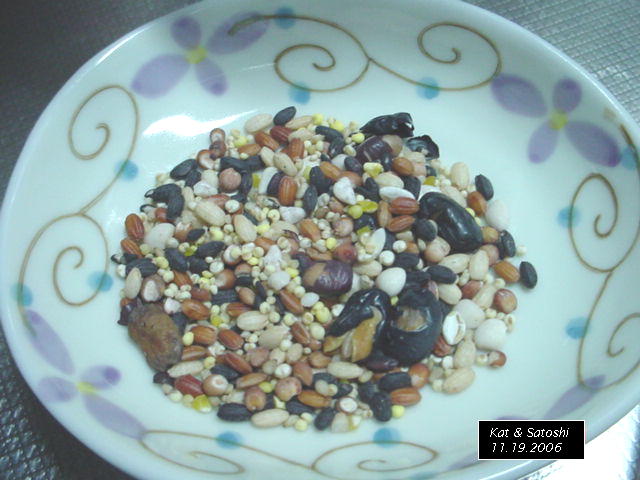 This is the 16-grain mixture by a company called HakuBaku. By adding grains to your rice, you can add more fiber and minerals to it. They also have a 5-grain mixture which I've also tried.